

The government plays a crucial role in promoting biogas adoption. The primary objective of the Biogas Government Scheme is to raise awareness about clean and green energy.
In recent months, the government has introduced various policies to increase investment and growth in the biogas sector.
The Government of India has announced guidelines for a new scheme to promote and support Compressed Bio Gas (CBG) producers. Under this scheme, biogas funding will be provided to purchase Biomass Aggregation Machinery (BAM).
This was notified through Office Memorandum No. L-16020/02/2023-GP-I (E-45833) dated 2nd February 2024.
By setting up more biogas projects in India, the country can better manage waste, reduce greenhouse gas emissions, and increase the production of renewable energy.
In this guide, we will explain how government policies shape the biogas industry under the renewable energy regulations.
What Is a Biogas Plant?
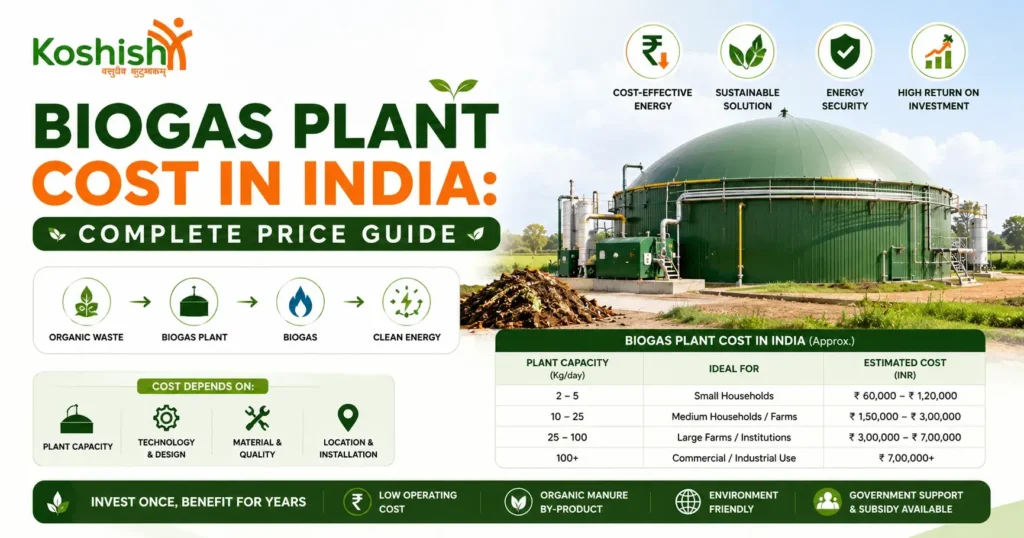
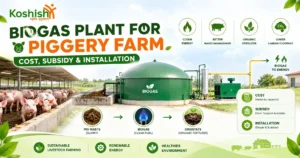
A biogas plant helps to convert waste food scraps or cow dung into renewable energy or biogas. It is a renewable energy solution that can be used for cooking gas and petrol, and CNG.
Biogas is a source of renewable energy that produces energy from anaerobic digestion. It provides a sustainable alternative to fossil fuels and helps to reduce greenhouse gas emissions.
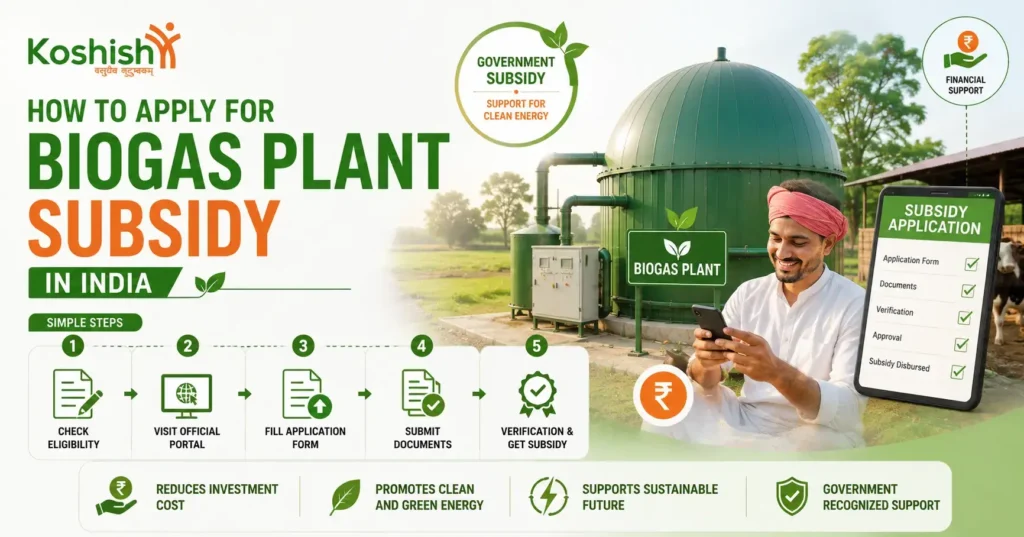
Under the biogas government scheme, you can install the plant and get additional benefits like a biogas subsidy, and you can request biogas funding from the government.
The biogas production process is completed through its three components.
- Reception Area.
- Fermentation Tank
- Gas Holder
Reception Area: For the anaerobic digestion process, raw material is received and prepared in the reception area. Each type of biogas plant has a different digester process, so biogas production depends on the raw material used.
Fermentation Tank: The digester is a waterproof tank and air-tight, which helps to enter biomass into the container. Here, you use raw material to generate energy.
The digester is a sealed, waterproof container where biomass is added. Inside, the raw materials are turned into energy. Biomass releases gas periodically, preventing layers from forming. When the process is finished, a pipe removes the leftover material.
Gas Holder: The gas holder is an air-tight container, usually made of steel, that collects gas produced during digestion. It has an outlet that allows the biogas to leave the system to be used to generate energy and heat.
The digester and gas holder can be used more than once, depending on how much waste you want to recycle or how much biogas you need.
How Government Policies Shape the Biogas Industry?
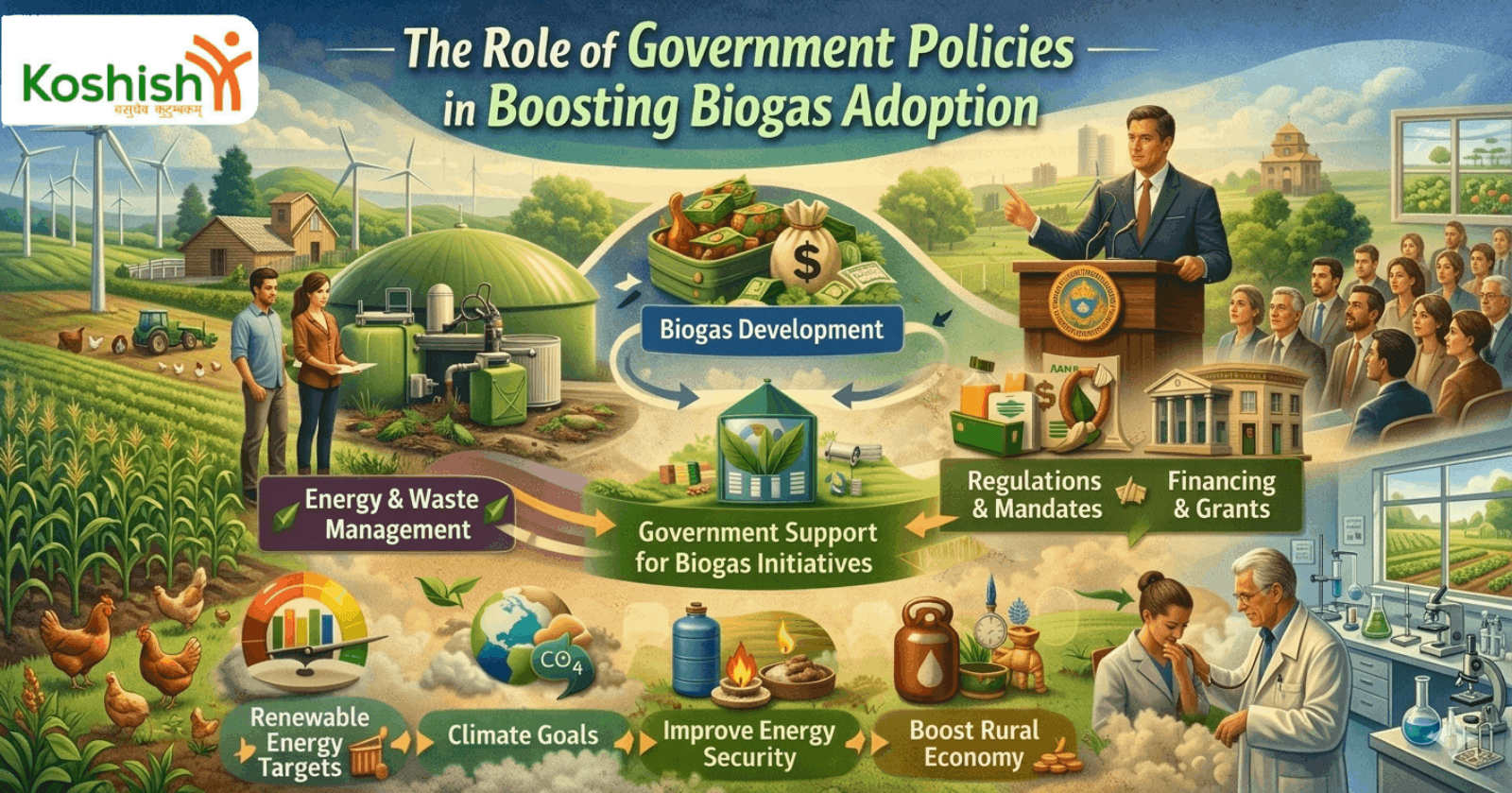
Government policies play a multi-role in the biogas industry to promote and increase the awareness of renewable and clean energy.
- The biogas government scheme is the main objective to promote the green energy sector.
- It helps to develop rural areas.
- The government provides a biogas subsidy for plant installation.
- Through the biogas incentives program, the government encourages individuals and businesses to invest in the renewable energy sector.
- The government is investing in a pipeline infrastructure to make the distribution process easy for CBG
- Access to biogas funding makes it easier for individuals and communities to invest in clean energy infrastructure.
- Biogas Incentives Scheme, like Gobardhan, that focuses on waste-to-wealth projects in rural locations.
- SATAT (Sustainable Alternative Towards Affordable Transportation) offers a policy framework to support the development of CBG and other bioenergy solutions.
India’s Biogas Policy & Renewable Energy Targets
To promote biogas in India and for future sustainability, India’s biogas policy & renewable energy set some valuable targets.
Features of the Biogas Program
- The MNRE annual target is to install small biogas plants in all states under the biogas program.
- They provide biogas funding on a quarterly basis for annual targets to designated PIAs and SND.
- The government uses the reimbursement method for small biogas plant installations on state rural development departments/ state Nodal Agencies, KVIC, and Mumbai.
- According to renewable energy regulations, CFA increased support for hilly & NER states, NER, ST, and SC caste beneficiaries for small biogas plant installation.
- The government provides a subsidy for biogas plants that use cow dung.
- The government’s biogas funding programs are designed to promote clean energy and reduce reliance on fossil fuels.
- The Biogas subsidy offered by the government makes renewable energy solutions more affordable for households and farmers.
- If the biogas plant is connected to a toilet at home and has a slurry filter, then the family can receive ₹1,600 more. It is applicable only to individual households, not to companies or big farms.
- The government offers extra ₹10,000 for using biogas to run a generator or a water pump. It is applicable to 10 to 25 cubic meters for small farms that use biogas plants.
How Can I Avail Financial Assistance?
You can avail CFA (central financial assistance) on a reimbursement basis after successfully biogas plant installation and commissioning in all aspects. The CFA transfers money to the beneficiary account.
Subsidies & Financial Incentives for Biogas Plants
According to the biogas government scheme, the government provides subsidies & financial incentives for biogas plant installation. The promotion of biogas in India plays an important role in reducing greenhouse gas emissions and supporting rural development. The subsidies & financial incentives amount depends on plant size.
- Those who live in North Eastern states, hilly areas, and those who belong to SC/ST categories government provides them a subsidy to install small biogas plants.
- Families who use cow dung biogas plants with toilets and a slurry filter, the government will provide them extra ₹1,600. It is applicable only for individual households.
- Farmers who use biogas to run a generator or a water pump (for 10 to 25 cubic meter plants) they can get extra money of ₹10,000.
- Medium-sized biogas plants in North Eastern states, islands, Gaushalas (cow shelters), and for SC/ST people get a 20% extra subsidy.
- For small biogas plants (1 to 25 cubic meters per day), the government gives a subsidy of ₹9,800 to ₹70,400.
CFA for Biogas Plants 1M to 25 M Biogas generation per day. Look at the table below to see how much subsidy you will get.
CFA for Biogas Plants 1M to 25 M
| Table – I | |||||||
|---|---|---|---|---|---|---|---|
| Sr. No | Particulars of CFA and States | Biogas plant ranging from size 1-25 cubic meters of biogas per day (₹) | |||||
| A | CFA Applicable | 1 M³ | 2-4 M³ | 6 M³ | 8-10 M³ | 15 M³ | 20-25 M³ |
| 17,000 | 22,000 | 29,250 | 34,500 | 63,250 | 70,400 | |
| All other states and categories | 9,800 | 14,350 | 22,750 | 23,000 | 37,950 | 52,800 | |
| B | Additionally Fixed Subsidy 1. If a Biogas plant is connected with a sanitary toilet. 2. If a biogas plant is linked with an MNRE-approved biogas slurry filter unit. | 1600 1600 | 1600 1600 | 1600 1600 | 1600 1600 | NA 1600 | NA 1600 |
| C | This fee includes the full work of building the biogas plant, supervision. It also includes free repair and maintenance for 5 years, so it works without problems. | The government gives ₹3,000 for each biogas plant of size 1 to 10 cubic meters and ₹5,000 for plants of size 15 to 25 cubic meters. This money is for the complete construction work of the plant. It is only for plants built on-site, like the Deenbandhu or KVIC models. It is not given for ready-made or factory-made biogas plants. | |||||
| D | Administrative Charges payable to PIA for the physical target achievement range of biogas plants (Amount in ) | ||||||
| 100 – 1,999 nos. of Biogas Plants. | ₹ 1,00,000 ^ | ||||||
| 2,000 – 5,000 nos. of Biogas plants | ₹ 10,50,000 ^^ | ||||||
| Above 5,000 nos. of Biogas plants | ₹ 24,50,000 * | ||||||
| E | Training Courses (Amount in ₹ per course) | ||||||
| ₹ 4,000 | ||||||
| ₹ 10,000 | ||||||
| ₹ 50,000 | ||||||
| ₹ 75,000 | ||||||
| F | Support for BDTCs | The government will provide financial support to Biogas Training Centers (BDTCs). This amount will help them pay for staff salaries, run training and skill development courses, and set up demo biogas plants. It will also cover awareness programs, materials, and other small costs. The support will be given according to the set targets. | |||||
| G | Incentive for saving fossil fuels & electricity. | The government provides an extra ₹10,000 for using a biogas-powered generator or water pump on small farms. This is for biogas plants between 10 to 25 M³ in size. The machine must run only on biogas (100%) to get this support. | |||||
The government gives extra money to the agencies (PIAs) that help set up biogas plants of size 1 to 25 M³. They get: ^. ₹500 extra for each plant after installing more than 100 plants. ^^. ₹450 extra for each plant after installing more than 2,000 plants. *. ₹400 extra for each plant after installing more than 5,000 plants. The maximum extra money they can get is ₹60 lakh. | |||||||
CFA for Medium-Sized Biogas Plant:
The government provides financial help (CFA) for medium-sized biogas plants that produce more than 25 to 2500 M³ of biogas per day.
The exact amount is shown in the Table below.
| Table – II | |||||
|---|---|---|---|---|---|
| Power generation capacity KW | Requirement of DPR | CFA ** limited to the following ceiling limit | Administrative Charges for PIA* | ||
| Power Generation | Thermal Application | Power Generation | Thermal Application | ||
| 3 KW – 50 KW | No | ₹ 45,000 per KW | ₹ 22,500 per Kweq thermal/cooling | 10% of the CFA | 5 % of the CFA |
| > 50 KW – 200 KW | Yes | ₹ 40,000 per KW | ₹ 20,000 per Kweq thermal/cooling | ₹ 2,00,000 fixed | ₹ 1,00,000 fixed |
| > 200 KW- 250 KW | Yes | ₹ 35,000 per KW | ₹ 17,500 per Kweq thermal/cooling | ₹ 2,50,000 fixed | ₹ 1,00,000 fixed |
- Administrative charges will be provided to the agencies (PIAs) for doing technical checks, sending project reports, and supervision.
**There is also a special 20% extra incentive for:
- North Eastern Region (NER)
- Islands
- Registered Gaushalas (cow shelters)
- SC/ST beneficiaries
How Does the Government Help Small Businesses?
Government renewable energy regulations support small businesses that use a biogas plant to reduce pollution and save energy. Biogas in India not only provides a renewable energy source but also supports agricultural communities by converting waste into useful resources.
- For small plants (1 to 25 M³), the biogas subsidy ranges from ₹9,800 to ₹70,400, depending on the size of the biogas plant.
- The government issues biogas incentives for setting up a CBG production plant as a part of the UP Energy Policy 2022.
- SATAT (Sustainable Alternative Towards Affordable Transportation) focuses on compressed biogas production from urban and agricultural waste to make retail outlets.
- Biogas subsidy schemes aim to promote rural development by supporting small-scale renewable energy projects.
The government provides financial support through subsidies and special biogas incentives
schemes.
It includes:
- Help to set up biogas plants
- Support for producing compressed biogas (CBG)
- Biogas government scheme programs like GOBARdhan and SATAT that increase awareness about the use of biogas and help sell biogas and its products.
Challenges in Implementing Biogas Policies
There are more challenges to implementing the biogas government scheme or policies, such as:
- Especially in rural areas, they are not aware of sustainable energy. They don’t know about the benefits of biogas plant installation and are not aware of the biogas government scheme.
- Not enough skilled workers to manage, run, and repair the biogas plant.
- Some customers do not manage the plant properly.
- Some customers are not able to manage cow dung or waste in the required quantity whole year.
- It is difficult to manage and track the thousands of biogas plants in rural areas.
- Late process of subsidies or more paperwork reduce the trust in renewable energy regulations.
Policy Changes Needed for Biogas Growth
The government’s focus on expanding biogas in India aligns with national goals for clean energy and environmental sustainability. But need to make changes in the biogas government scheme to increase the awareness of biogas plants and sustainable energy solutions. Here are some changes that should be implemented in policies.
- Launch a campaign in rural and urban areas to make people aware of biogas benefits and government schemes.
- Less paperwork and make a biogas subsidy and biogas incentives application easy and faster.
- Trained local workers to manage the biogas plant easily through government programs.
- Manage a one-stop platform for all work, including approvals, registration, and finance for the biogas plant.
- Promote the private sector and small businesses, and provide biogas incentives so that they can offer biogas-related services and products.
Final Thought
The Indian government is helping people use biogas through its biogas government scheme. It provides financial support, subsidies, and incentives to farmers, homeowners, and small businesses to build biogas plants. It helps manage waste, save fuel, and protect the environment.
Programs like SATAT and GOBARdhan make people more aware of how biogas can be useful.
But there are still some problems, like a lack of awareness in villages, not enough trained workers, and complicated paperwork.
The government should make the process easier and faster, spread more awareness, and train local people.
If these changes are made, biogas can grow faster in India and help us build a cleaner and greener future.
Frequently Aasked Qestions
What is the cost of 1 kg of biogas?
According to the Indian Biogas Association, the cost of biogas depends on various factors such as compression and purity. A fixed cost of 1kg of biogas is 90 ₹, it is a fixed cost.
Is biogas cheaper than LPG?
Yes, biogas is cheaper than LPG, and biogas is produced from organic waste and reduces storage costs. You can save up to 50% if you switch from LPG to biogas for cooking and heating.
How much cow dung for 1 kg of biogas?
You will need 55 to 60 kg of cow dung to produce 1kg of biogas.
What is the subsidy for biogas production?
The Ministry of New and Renewable Energy (MNRE) provides financial support for setting up biogas plants.
Biogas government scheme for small plants (1 to 25 M³ per day), the subsidy ranges from Rs. 9,800 to Rs. 70,400, depending on the size and type of the plant.