

A sustainable alternative to Fossil Fuels, delivering Efficiency and Lower Emissions, which transforms Organic Waste into a Reliable, Future-Ready Energy solution.
Our CBG Plant is a renewable, eco-friendly fuel produced by further processing biogas derived from organic waste, agricultural waste, and cow dung, as well as poultry litter. The Compressed Biogas (CBG) procedure involves biogas undergoing purification and compression, resulting in a high-quality, methane-rich gas that can be used as a substitute for natural gas (CNG), LPG, or diesel in industrial, commercial, and transportation applications.

5 Operational Project For compressed biogas
A glimpse into our Projects where we created a cleaner, greener, and smarter infrastructure for our clients.
5 Operational Compressed Biogas Applications are as follows
Agriculture & Rural Energy
Farmers can use CBG for irrigation pump sets, tractors (dual-fuel models), and rural micro-grids, promoting energy independence in villages.
Industrial Thermal Energy
Industries such as food processing, ceramics, textiles, and pharmaceuticals use CBG in boilers and furnaces as a cleaner, cost-effective alternative to LPG or diesel.
Power Generation
CBG efficiently runs gas engines to generate reliable electricity, making it ideal for commercial units, industrial operations, and rural energy applications.
Cooking Fuel (LPG Replacement)
Hotels, restaurants, canteens, and large kitchens can use CBG in place of LPG, reducing cost and dependence on fossil fuels.
Transportation Fuel (CNG Replacement)
CBG can directly power CNG vehicles, cars, autos, buses, and trucks, offering a cleaner, renewable fuel choice with significantly lower emissions.
We use non-cryogenic gas separation technology, employing high pressure to separate gases and employing a hybrid approach that alternates between pressure and vacuum to regenerate the adsorbent material.
Step 1:- Preparation (Pre-Treatment)
Before using the VPSA Method, the raw Biogas is again treated to remove moisture (H2O) & sulphur compounds, such as hydrogen sulfide (H2S), which can irreversibly damage the adsorbent material. These materials can corrode equipment and permanently damage the adsorbent, making this purification step essential & efficient for the operation.
Step 2:-Adsorption ( Pressurisation)
Step 3:- Desorption (Regeneration)
Step 4 :- Continuous Operation
To maintain a steady, reliable supply of purified gas, commercial VPSA systems operate with at least 2 adsorption towers. While one tower actively adsorbs impurities from the biogas, the second tower undergoes regeneration, ensuring smooth, uninterrupted gas production.
Another method we use is Water Scrubbing, where pressurized water separates impurities like CO2 and H2S from CH4. A bedding system inside the column increases gas-water contact, allowing soluble gases to dissolve, while CH4 remains mostly unaffected. H2S is highly soluble, CO2 moderately soluble, and CH4 minimally soluble. Below is the procedure:
Step 1:
The Raw Biogas enters from the bottom of a tall tank, also known as a Water Scrubber. It is pretreated to remove moisture and dust particles. The gas is then compressed to improve absorption efficiency. It enters from the bottom of the tall scrubber column.
Step 2:
The water flows down as it is sprayed from the top of the tank. The water flows downward through the packed column by gravity. This creates a counter-current flow with rising gas. The design ensures uniform distribution and better purification.
Step 3:
As the Biogas level rises, the water level falls; the two are mixed. The gas rises, and water falls; intense mixing takes place. Thin water films are formed over packing surfaces. This improves mass transfer and absorption efficiency.
Step 4:
Carbon Dioxide (CO2) & Hydrogen Sulfide (H2S) dissolve readily in water, while methane gas does not, so it stays. Thus, methane concentration increases naturally, separating it from other gases.
Step 5:
The processed biogas is purified, methane-rich biogas that comes out of the Top.The gas is further dried to reduce the moisture content. Purity typically reaches 90–97% methane.
Step 6:
The tank drains unused water with CO2 and H2S, which can then be treated further or recycle.The treated water is collected in a regeneration tank. It is then recirculated back to the scrubber system.
Get personalized guidance on designing, installing, and optimizing your residential solar system for maximum savings and efficiency.
5 Operational Project For compressed biogas
Bagasse
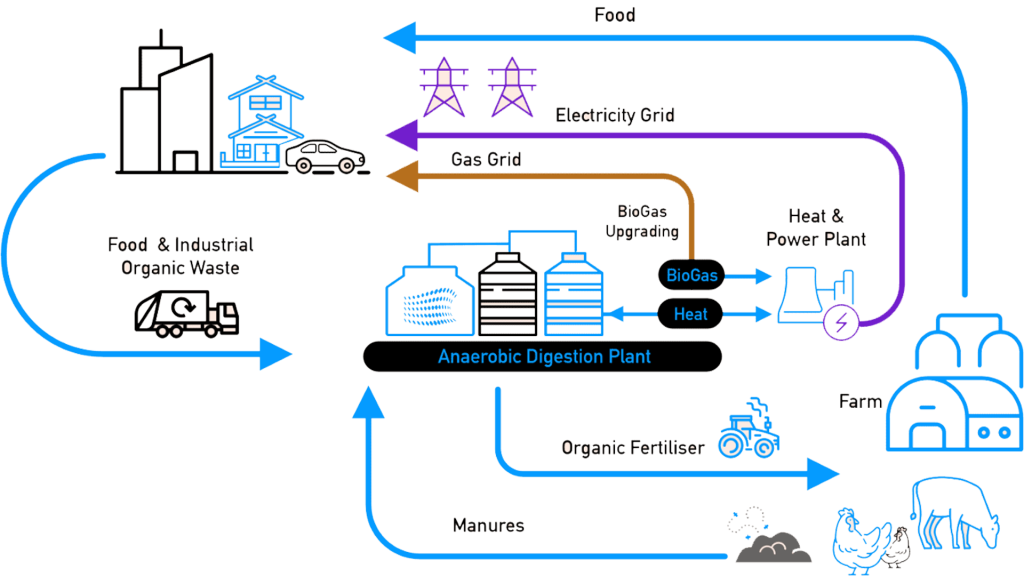
Bagasse, the fibrous residue left after extracting juice from sugarcane, serves as an excellent feedstock for biogas and CBG production. With high cellulose and hemicellulose content, it digests well when pre-treated for anaerobic processes. Sugar mills benefit by converting surplus bagasse into renewable energy instead of disposing of it or burning it.
Along with biogas, the process yields organic slurry that improves soil fertility and reduces dependence on chemical fertilisers. Using bagasse for CBG generation helps sugar industries cut waste, reduce emissions, and improve overall sustainability.
Napier Grass
Napier grass is an ideal energy crop for biogas plants because it grows easily over large areas and is easily harvested. Its economic value increases when market conditions favour the sale of its by-products. This hardy tropical species is highly resilient, tolerating drought and dry climates. With exceptional biomass yield and strong biomethane potential, Napier grass (Pennisetum purpureum) serves as a major renewable energy resource.
Its rich organic profile, 30.9% carbohydrates, 27% protein, 14.8% lipids, 18.2% ash, and 9.1% fibre, makes it perfectly suited for biogas production. Depending on the variant, Napier grass can produce 100–180 tons per acre annually, ensuring sustainable income opportunities for farmers.
Press Mud
Press mud, a key by-product of the sugar industry, is now increasingly valued as a promising feedstock for producing Compressed Biogas (CBG). This material offers sugar mills across India a strong opportunity to earn additional revenue by processing it through anaerobic digestion. As a natural residue generated during sugarcane processing, press mud is highly suitable for bio-methanation.
Its conversion into biogas also produces nutrient-rich organic fertiliser that enhances soil quality and supports sustainable agriculture. Farmers linked with sugar mills, along with other agricultural users and manure suppliers, gain year-round access to high-quality organic manure from these biogas plants.
Cow Dung
Cow dung is one of the most reliable and widely used feedstocks for biogas generation due to its steady availability and balanced organic composition. When processed in anaerobic digesters, it produces clean biogas and nutrient-rich digestate that works as an excellent organic fertiliser.
Rural households, dairy farms, and commercial gaushalas benefit from cow dung-based biogas plants for cooking fuel, electricity, and CBG production. Its year-round availability, easy handling, and high methane yield make cow dung an essential input for sustainable energy projects.
Poultry Waste
Poultry litter, comprising droppings, bedding materials, and spilt feed, is an energy-dense substrate ideal for producing biogas and CBG. Its high nitrogen and organic content ensure strong biomethane output, making it a valuable resource for poultry farms looking to manage waste efficiently.
Through anaerobic digestion, poultry litter is transformed into renewable gas and high-quality organic fertiliser. This helps farms reduce odor, minimise waste disposal problems, and turn waste into a profitable, eco-friendly energy solution.
Piggery Waste
Piggery waste is another rich and efficient feedstock for biogas and CBG production, known for its high methane potential and consistent availability. Pig farms generate significant quantities of biodegradable waste, which can be easily treated through anaerobic digestion.
The resulting biogas can be upgraded into CBG, while the digestate serves as a potent organic manure. Utilising piggery waste for biogas plants not only solves waste management challenges but also supports farmers with energy savings and additional revenue generation.