


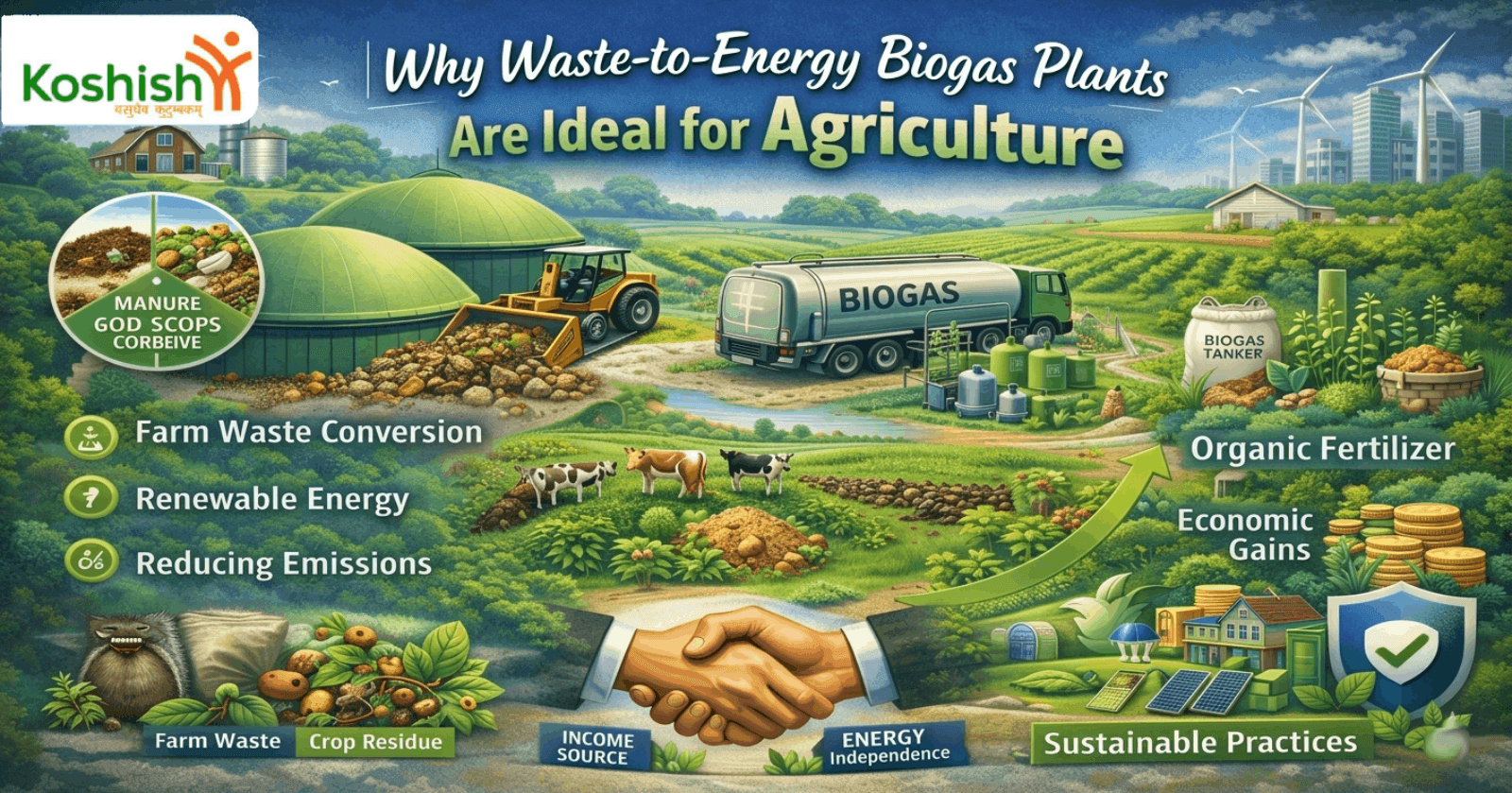
Types of Agricultural Waste Usable
Agricultural Waste Biogas is highly diverse, and one of the biggest parts of waste-to-energy biogas plants is their ability to process multiple organic feedstocks, regardless of the nature of the organic waste. When properly segregated and managed, these wastes become valuable resources for renewable energy generation and organic manure production. The major agricultural wastes Biogas is made, which are as follows: Crop Residues : After harvesting, large volumes of crop residue remain in the fields. Instead of burning or dumping them, these materials can be effectively used in waste-to-energy biogas plants.- Examples: Paddy straw, wheat straw, maize stalks, sugarcane trash, cotton stalks
- Benefit: Reduces stubble burning, lowers air pollution, and converts waste into energy
- Examples: Cow dung, buffalo dung, poultry litter, goat, and sheep manure
- Benefit: Provides consistent biogas yield and improves nutrient recovery for soil application
- Examples: Rice husk slurry, sugarcane press mud, molasses waste, fruit pulp, oilseed cakes
- Benefit: High biogas potential and easy availability near agro-industrial clusters
- Examples: Vegetable waste, fruit peels, flower waste, banana stems, coconut husk slurry
- Benefit: Converts perishable waste into stable energy and nutrient-rich digestate
- Examples: Leftover feed, spoiled grains, expired produce, canteen waste
- Benefit: Enhances biogas output when co-digested with manure or crop residues
- Examples: Napier grass, maize silage, sorghum biomass
- Benefit: Ensures year-round feedstock supply and stable plant operation
- Biogas yield and plant efficiency
- Digester stability and lifespan
- Quality of bio-slurry used as organic fertilizer
Biogas Energy Independence for Agricultural Farms
The Biogas Plant has given huge relief to the Agricultural farms by providing them with farm waste management. It becomes easy for the farmers to manage the agricultural waste biogas is produced, through which cooking gas, electricity, and manure are produced, which can be used for their own purposes or can be sold in the market for a reasonable price.What is the Procedure of the Waste-to-Energy Biogas Plant?
Biogas production offers a viable solution for handling agricultural waste, and renewable energy from waste is produced from it. Koshish Sustainable Solutions provides a straightforward approach to tackle this issue with a budget-friendly solution. As you may be aware, biogas consists of a blend of various gases, but it can only be utilized effectively when these gases are separated from one another. Their making and separation process is stated below: In-let Tank: The first step is to mix the agricultural waste in the In-let tank. The Agricultural Waste and water are added in the same proportion, and a mixer machine is already installed in the tank, which mixes the water and agricultural waste well and turns it into a Liquid State, which then is passed on for further processing. Digester Tank: The main tank where the procedure of Biogas is done. Here, the cow dung is mixed with the agricultural waste, as cow dung already has anaerobic bacteria, which break down the agricultural waste so that the methane gas can be formed for further anaerobic digestion processes. It takes approximately 40 days for the methane gas to form. The Gas is separated from the pipelines, whereas the remaining slurry is processed further into the Out-let Tank. Out-let Tank: It plays a vital role in the Biogas process. After the anaerobic digestion process, where the agricultural waste is broken down, and a slurry is formed, the Biogas is already extracted in the Digester from the remaining manure and slurry. The Digested slurry is poured into the Out-let Tank, where it is further processed into the Separator. Separator: To process the remaining manure and water further, it is poured into the Separator tank, where it is processed, and the water is separated from the hard particles. The water is processed further for re-use in the Water Tank and the hard particles are kept aside for further usage as manure in the farm fields or for selling in the market. Water Tank: This is the last Tank where the separated water is filled and processed either for reuse in the Agriculture farm or the in-let tank.Rural and semi-urban Installations of the Biogas Plant
Biogas plants have been effectively adapted to suit both rural and semi-urban installations by customizing their design, scale, and mode of operation according to local conditions. In rural areas, biogas plants are closely integrated with agriculture and livestock activities, using readily available cattle dung, crop residues, and farm waste management to produce energy for cooking, irrigation, and household needs, while the generated bio-slurry is reused as organic fertilizer to improve soil health. In semi-urban areas, the same biogas technology is scaled up and modified to handle mixed organic waste such as food waste, vegetable market waste, and agro-processing residues through co-digestion, with energy being utilized for electricity generation, Bio-CNG production, or community-level applications. This flexibility in feedstock handling and energy use has allowed biogas plants to seamlessly fit into both rural and semi-urban ecosystems, making them a reliable solution for decentralized energy generation, effective waste management, and sustainable development.Wrapping Up
Waste-to-energy biogas plants represent a practical and future-ready solution for agriculture, where waste management, energy generation, and soil health improvement come together in a single system. By converting crop residues, animal waste, and agro-processing by-products into clean biogas and nutrient-rich bio-slurry, these plants help farmers reduce input costs, manage waste responsibly, and improve overall farm productivity. For both rural and semi-urban agricultural ecosystems, biogas plants offer decentralized energy, reduced dependence on fossil fuels, and a sustainable alternative to waste disposal practices such as burning or dumping. Most importantly, they support circular agriculture, where nothing is wasted, and every byproduct adds value.Frequently Asked Questions
What is a waste-to-energy biogas plant?
A waste-to-energy biogas plant converts organic agricultural waste such as crop residues, animal dung, and food waste into biogas through anaerobic digestion. The biogas is used for cooking, electricity, or bio-CNG, while the leftover bio-slurry is used as organic fertilizer.
Which types of agricultural waste can be used in biogas plants?
Waste-to-energy biogas plants can process cattle dung, poultry litter, crop residues, vegetable and fruit waste, agro-processing by-products, and food waste. A balanced mix of feedstock improves gas yield and plant efficiency.
Can biogas plants work in semi-urban agricultural areas?
Absolutely. In semi-urban areas, biogas plants handle mixed organic waste from farms, markets, and food units. They are often used for electricity generation or Bio-CNG production, supporting both agriculture and local energy needs.
What government support is available for agricultural waste biogas plants in India?
Government initiatives such as GOBAR-Dhan, SATAT, and renewable energy subsidy schemes support biogas plant installation, making them financially attractive for farmers and agri-enterprises.
Is operating a biogas plant complex?
Modern biogas plants are designed for ease of operation, with automation and simple maintenance practices. Basic training is sufficient for daily operation and monitoring.