
Biogas Plant Cost based on Bird Counts
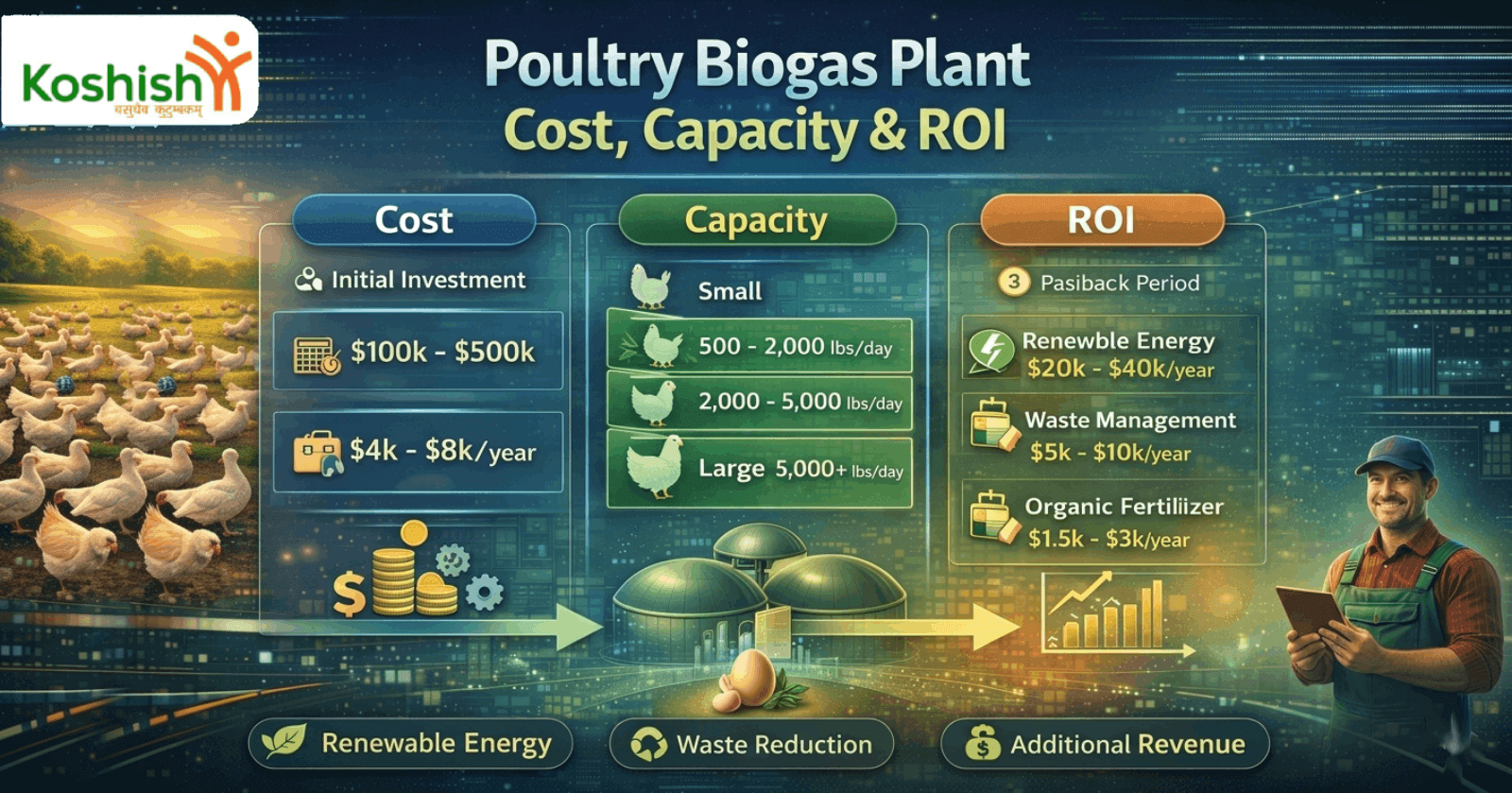
This is a major thing that should be kept in mind: when getting a biogas plant installed, the size depends on the bird count in a poultry farm. A very important factor. The size depends on the number of birds. The more birds, the more poultry biogas plant capacity will be installed since it will have the capacity to generate a large amount, Gobargas. For example, if in a poultry farm there are 20,000 birds, then the estimated poultry biogas plant cost would be around 50 lakhs. The poultry biogas plant capacity would be 100 cum, and the power generation would be around 10 kW.Land & Infrastructure Needs for Installing a Biogas Plant
To build a biogas plant, a huge piece of land & infrastructure is needed. It also depends on the poultry biogas plant capacity. There are many more factors that need to be kept in mind before installing the biogas plant. Poultry Biogas Plant Capacity: A commercial biogas plant requires 1-5 acres of land to build a poultry biogas plant capacity of 100-200 cubic meters. An even larger Biogas plant needs over 5 acres of land. Location: It is a very important factor that needs to be prioritized, as the poultry biogas installation cost is being used. What is the location where the biogas plant is being installed? The location should be nearby so that the Gobar gas can be used directly or can be distributed easily; the same goes for the electricity. It should be far away from flooding areas or waterbodies. Feedstock Availability: The feedstock availability should be there all the time. This is also a must. Site Suitability: The access of the road should be there. The land must be flat without any heavy bumps and clean so that installing the biogas is easy.Biogas Plant Payback period
Biogas plant payback periods generally range from 1.5 to 6 years, depending on plant size, feedstock costs, and local incentives. Small household systems have a poultry biogas ROI of under 2 years, while large industrial/commercial plants (e.g., compressed biogas) typically have a 3–5-year ROI. Key factors influencing this include subsidies, energy prices, and efficient waste utilisation. Key poultry biogas ROI Factors and Variations Small-Scale/Household Plants: Often have a rapid payback, sometimes under 2 years (e.g., 2.4 plants), due to low initial costs and high savings on LPG/wood. Industrial/Commercial Plants: A well-managed industrial plant (e.g., 1 MWe) usually recovers investment in 3-5 years. Large-Scale/Utility Plants: Larger, high-efficiency plants (5 MW) typically see payback in 3-4 years. Influencing Factors: High investment costs (CAPEX) can push payback closer to 6–9 years, while high-efficiency compressed biogas (CBG) projects with subsidies can have quicker 3-4 year returns.Financial Feasibility of Biogas Plant
Biogas plants are generally financially feasible, offering high profitability through energy sales (electricity/CNG) and fertiliser, particularly with government subsidies. Small-scale plants often show higher relative returns, while large-scale projects, such as 350 TPD units, require significant capital expenditure, often over ₹200 crore, with roughly 45-50% ROI. Payback periods usually range from 3 to 5 years, depending on poultry biogas subsidy availability and operational efficiency. Key Financial Aspects: High Initial Cost: Small-scale plants can cost over 10,000, while large commercial Compressed Biogas (CBG) plants (e.g., 250 TPD) in India can exceed ₹200 crore. Revenue Streams: Income is generated from the sale of compressed biogas (CBG/CNG), electricity (power-to-grid), and bio-manure. Profitability & Payback: Studies indicate a 3 to 5-year payback period. Smaller plants can offer faster returns (<3 years), while larger projects can provide significant long-term ROI. Operational Costs (OPEX): Significant costs include labor, feedstock management (cow dung, agricultural waste), and maintenance. Profit Drivers: Key success factors include government subsidies, consistent feedstock supply, and high-efficiency operations.Wrapping Up
The poultry biogas plant cost depends on many factors that we have discussed above. Though poultry biogas subsidy is available for CBG plants & commercial plants, since they are large-scale plants, which are in Crores, it can be difficult for the farmers to build, so the Government of India supports by providing poultry biogas subsidy.Frequently Asked Questions
How is the capacity of a poultry biogas plant determined?
The capacity of the plant is primarily based on the amount of poultry litter available per day. A farm generating 1–2 tons of waste daily can install a small plant of 25–50 m³ capacity, while farms producing 5–10 tons may require 100–300 m³ systems. Larger facilities handling more than 20 tons per day usually opt for industrial-scale or CBG plants for efficient waste utilisation.
How much biogas can be produced from poultry litter?
Poultry litter is a high-energy feedstock, and on average, one ton of poultry waste can generate around 50–80 cubic meters of biogas. This gas can be used for cooking, electricity generation, or upgraded into compressed biogas (CBG) for commercial use, making it a valuable energy resource.
What is the ROI of a poultry biogas plant?
The return on investment for poultry biogas plants is generally attractive, especially for medium and large-scale projects. Most plants achieve a payback period of 3 to 6 years, depending on utilization efficiency and revenue streams. Income can be generated through energy savings, sale of biogas or CBG, organic fertilizer (bio-slurry), and carbon credits.
Are there any government subsidies available for biogas plants in India?
Yes, the Government of India provides financial assistance for biogas plants through schemes by the Ministry of New and Renewable Energy (MNRE). These subsidies help reduce the initial capital investment and encourage adoption, especially for small and medium-scale plants.
What is the Profit margin of the biogas plants?
The biogas plants, especially the compressed biogas plant, are highly profitable, with an estimated ROI of approximately 40%-45% and a 20% profit margin from selling the biogas and the manure generated during production.