

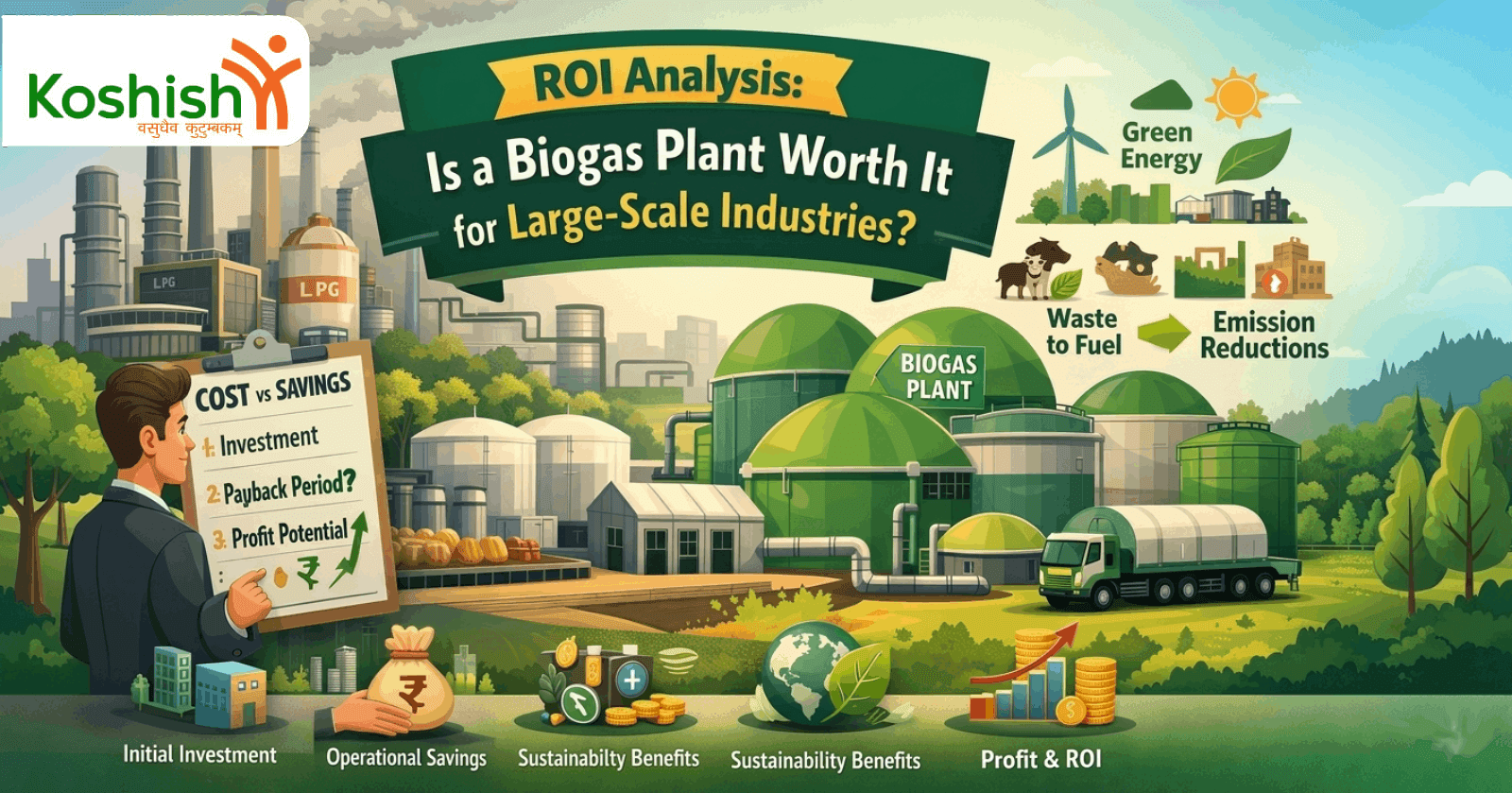
Biogas ROI industrial projects play an important role in helping large-scale industries manage large amounts of organic waste by converting it into clean energy. But is it really worth the investment? Understanding the biogas ROI industrial projects can offer and the payback period is key.
In this blog, we will explain the costs, benefits, and savings of Industrial or Commercial Biogas plants to help you decide if this sustainable solution is right for your business.
Difference Between Capex vs Opex in Biogas
Capex and Opex are both financial models that help to buy & set up a large biogas plant. Choosing the right model can directly affect your biogas ROI industrial project.
Capex: It is a capital expenditure model. The company makes an upfront investment cost to buy and setup a large biogas plant. Under this model company is fully responsible for operations & maintenance.
It is mentioned in the long term asset in the company balance sheet. The biogas ROI industrial under Capex can be higher if waste availability is consistent.
Opex: It is a operational expenditure model and common used models in BOOT (Build-Own-Operate-Transfer).
Under this model, service provider invests in biogas system at client site. Service provider also builds and operates the biogas system. The client only pays for consumed energy, without needing fund to set up.
Capex vs Opex in Biogas | ||
|---|---|---|
| Features | Capex | Opex |
| Initial Investment | Large upfront cost | Zero upfront cost |
| Duration | Generally takes 2-5 years, depending on project scale | Immediate Savings |
| Risk Ownership | All risks are borne by clients | Service providers take operational risks |
| Maintenance & Responsibility | Operational & maintenance client internal team | Service providers |
| Depriciation | Record on the company balance sheet | No need to record in client books |
| Upgrade Technology | It requires a new Capex financial model | Easy to upgrade technology |
Energy Cost Comparison with Conventional Fuels
If we compare biogas energy cost and conventional fuels, biogas energy is more cheaper than conventional fuel.
Biogas energy is a perfect solution for industry because it produces enough energy from organic waste that can easily run company operations without any interruptions. It saves energy cost, reduces operational fuel costs and provides independent energy.
Biogas Vs. Conventional Fuels | ||
|---|---|---|
| Features | Biogas | Conventional fuels |
| Upfront Cost | It requires a high upfront cost due to construction and equipment. | It requires a low upfront cost. |
| Long Term Cost | Long term cost is low due to low cost of organic waste. | Its long term cost is high due to fluctuation in the price of conventional fuels. |
| Environmental Impact | Biogas plants reduce carbon emissions. | As compared to biogas, it pollutes more and generates carbon gas. |
| Infrastructure | It requires a digester, tanks, and other equipment to set up a biogas plant. | Its already set up. |
How to Calculate Payback Period for Your Biogas Plant?
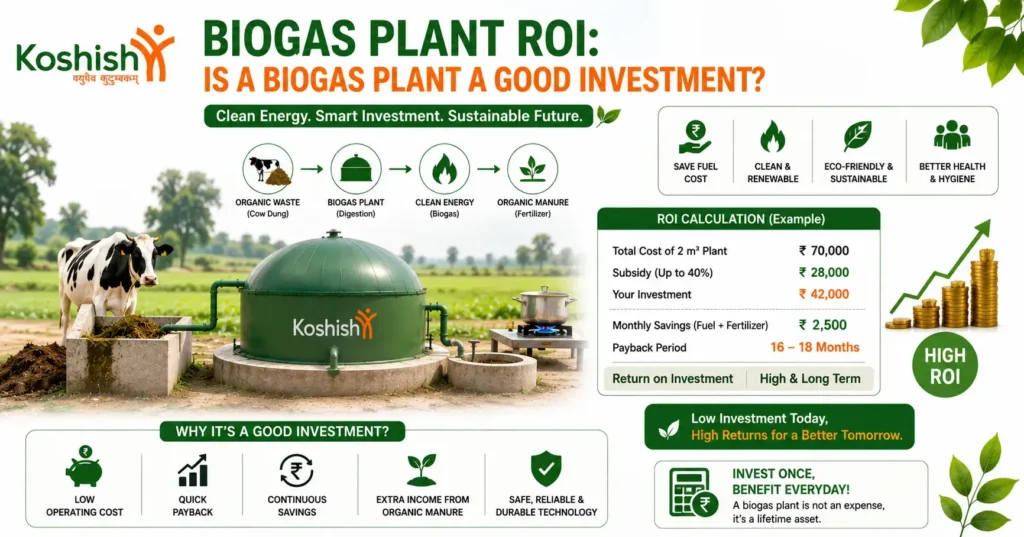
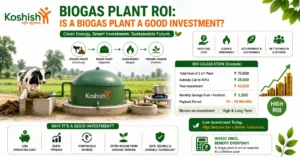
You can calculate the payback period of your biogas plant by dividing the initial investment by the annual net income. It includes what you earn from energy generation and industrial energy savings.
Formula
Payback Period = Initial Investment Cost / Annual Net Income
For Example:
A factory invests ₹50 lakh in a biogas plant. Each year, it earns ₹12 lakh from energy generation and ₹3 lakh in industrial energy savings, giving a total annual benefit of ₹15 lakh.
₹50,00,000 ÷ ₹15,00,000 = 3.33 years
So, the payback period is 3.33 years.
What Documents Are Required for a Biogas or Gobar Gas Plant Setup?
You will be required a some essential documents for the Biogas or Gobar Gas plant setup. Look at the points below and prepare documents to install a biogas plant.
Site Clearance: It is the initial step, you will need approval from the local authority and confirmation of land allocation for the plant.
Environmental Clearance: It is required if community solid waste is used in the biogas process.
CTE (Consent to Establish): You will need CTE from the State Pollution Control Board before starting construction at the site.
CTO (Consent to Operate): Before starting plant operations, you will have to carry CTO for at least 30 days.
Projected Returns: After calculating the basic estimate of expected financial returns, you will have to submit it with the CPCB application.
Solid Waste Management Report: Submit Solid Waste Management report that shows how you will handle waste and processing.
Land Documents: You will need to submit land ownership documents or a lease deed, a rent agreement, or purchase papers.
Site Selection Committee Approval: Permission from the district-level committee for the proposed project site.
PESO License: You will need to get approval from the Petroleum and Explosives Safety Organisation.
Note: To set up a biogas plant, you may need some extra documents apart from those mentioned above. However, if you choose a well-reputed company like Koshish India, an expert team will guide you required documents and provide end to end solutions.
Wrapping Up
A biogas plant can be a smart investment for industries, especially for a large amount of organic waste available. With a proper cost-benefit analysis biogas, industries can clearly understand the long-term value.
Many companies see strong biogas ROI industrial benefits because biogas helps reduce fuel costs and provides reliable industrial energy savings over time. It also helps in meeting Company ESG goals.
When comparing Capex vs Opex models, both have their benefits, but Opex makes adoption easier with zero upfront cost. No matter which type of model, calculating the payback period helps industries get ROI within 3-4 years.
Frequently Asked Questions
What is the typical ROI for industrial biogas plants?
Industrial biogas plants generally provide a biogas ROI industrial within 3-4 years. It depends on the availability of waste and current fuel costs. Most manufacturing units recover their investment within 2–4 years.
What is the payback period for an industrial biogas plant?
The payback period for most industrial biogas plants ranges between 3-4 years, depending on the technology, daily waste generation, and energy consumption patterns of the manufacturing unit.
How does biogas score in a cost-benefit analysis for industries?
A cost-benefit analysis biogas model provides benefits for industries such as, reducing fuel costs, reducing waste disposal costs, carbon credit earnings, and long-term energy independence.
Over 8–10 years, industries often save 3–5 times their initial investment through consistent energy generation and reduced operational costs.
What is the main benefit of installing a biogas plant for industries?
The main benefit is cost savings. Biogas replaces costly conventional fuels like LPG, diesel, and natural gas, helping industries reduce operational costs while generating clean & renewable energy.