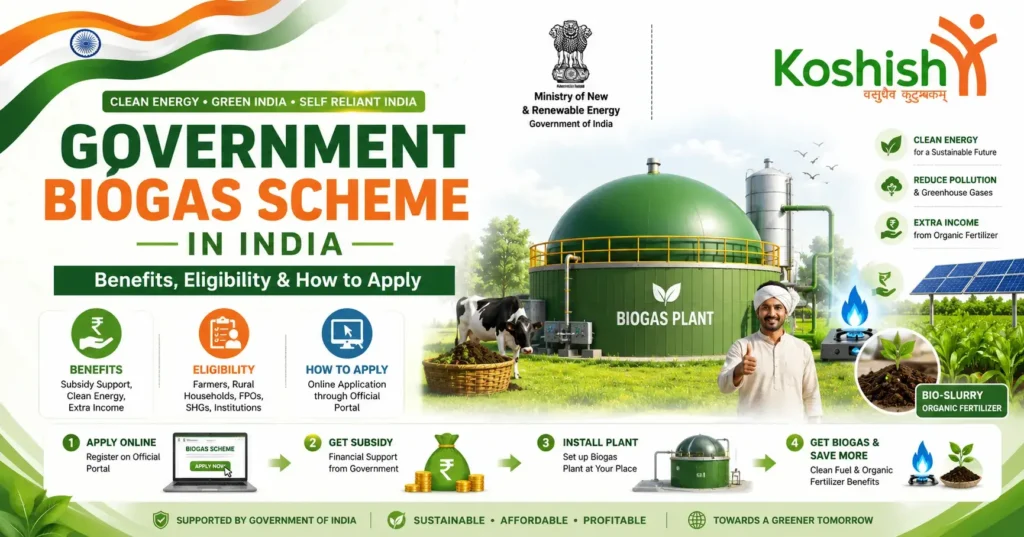

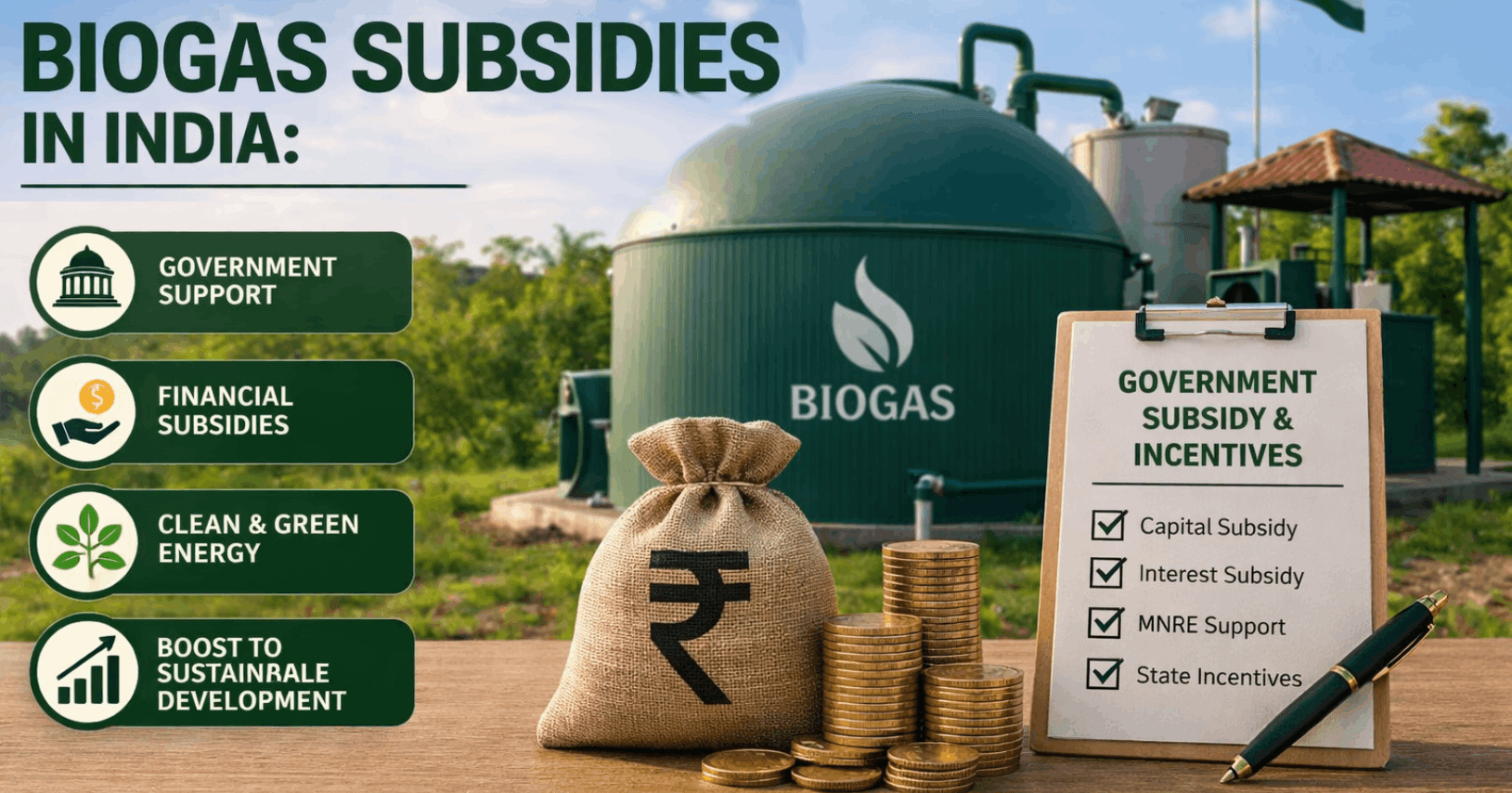
India’s push towards sustainable energy is opening new ways for biogas as a reliable and eco-friendly fuel. To move this shift forward, the Government of India, through initiatives such as the MNRE biogas scheme. The scheme offers a variety of subsidies & incentives that make biogas plant projects not only sustainable but also financially attractive. The government supports biogas projects through tax benefits under the Biogas Subsidies in India. These initiatives encourage farmers, businesses, and industries to convert organic waste into clean energy, generate income, and have a positive impact.
What are the Eligibility Criteria?
Eligibility criteria for procuring biogas subsidies in India, or for Central Financial Assistance under MNRE, depend on the project type.
For Small / Household Biogas Plants under the MNRE Biogas Scheme(NNBOMP – MNRE)
- The farmer or other person should have land or space (50-60 sq. m) available for installation.
- A regular supply of organic waste. Such as cattle dung or poultry litter. Should be available maximum time.
- The beneficiary must pay their own share of the cost beyond the subsidy.
- The MNRE must approve the plant design.
- An additional subsidy is provided for biogas plants linked to the system if they are connected to a toilet or a slurry filter.
For Large / CBG Plants (SATAT & MNRE Bioenergy Programme)
- The minimum capacity is approximately 2 TDP CBG (or equivalent biogas output).
- Must use ≥50% biomass feedstock or at least 3,000 MT/year.
- The project must demonstrate 25–50% construction progress before the subsidy is released.
- No duplicate subsidy from other schemes or overlapping renewable energy incentives is permitted.
- Applicant: Indian company/entrepreneur / cooperative / SPV.
- Preferably, have a Letter of Intent (LOI) from OMCs under SATAT.
Subsidies & Financial Incentives for Biogas Plants
Under the MNRE biogas scheme, the government provides subsidies & financial incentives for installing biogas plants. Promoting biogas in India plays a vital role in reducing greenhouse gas emissions and supporting rural development. The amount of subsidies & financial incentives depends on plant size.
- The government provides subsidies to individuals living in northeastern states and hilly areas, as well as to those belonging to SC/ST categories, to install small biogas plants.
- Families who use cow dung biogas plants with toilets and a slurry filter will receive an extra ₹1,600. It is applicable only for individual households.
- Farmers who use biogas to run a generator or a water pump (for plants with a capacity of 10 to 25 cubic meters) can receive an additional ₹10,000.
- Medium-sized biogas plants in the northeastern states, islands, and Gaushalas (cow shelters) for SC/ST people receive a 20% extra subsidy.
- For small biogas plants (1 to 25 cubic meters per day), the government provides a subsidy ranging from ₹9,800 to ₹70,400.
What is the Application Process in the Procurement Subsidy?
The procedure of the Application is simple, and the steps for that are as follows:
- Identify the Biogas Scheme: First, determine whether your project falls under the MNRE Biogas Scheme or another biogas program, as this will inform the Biogas plant design.
- Check Eligibility: Requirements for raw materials, including land, feedstock, financial share, and design.
- Select Plant / Vendor: MNRE-approved model or authorised provider.
- Prepare Documents: ID, land proof, feasibility report, feedstock proof, and bank details.
- Submit Application: Through the State Nodal Agency or the MNRE / SATAT portal.
- Inspection & Approval: Authorities verify site, design, and feasibility.
- Subsidy Sanction: Financial assistance is approved, sometimes on a milestone basis.
- Installation & Commissioning: The plant was installed under supervision.
- Post-Installation Verification: Functionality checked; final subsidy released.
What are the Common Challenges faced for procuring MNRE subsidy?
There are numerous barriers to applying for biogas subsidies in India. Here are some of the Common challenges that are faced:
Procedural & Administrative Challenges: In the administrative process, there is a delay in fund reimbursement. The people are not even aware of the MNRE biogas scheme and other renewable energy incentives. Such as biogas subsidies in India, which create challenges for the public seeking to access them. The application sometimes becomes hectic, too.
Financial & Economic Challenges: While processing the application for the procurement of the subsidy. Sometimes, high transaction costs and high upfront costs can be a problem for small households. The cost of a biogas plant can be higher after the acquisition of biogas subsidies in India.
Technical & Infrastructural Challenge: There are a few subsidy options tied to specific biogas plant designs. The biogas subsidy process faces technical challenges such as inconsistent plant quality, feedstock mismatches, and a lack of skilled installation. Infrastructural issues include poor transportation, a weak grid or storage, and delayed inspections. Gaps in monitoring and digital tracking further slow approvals. Together, these hurdles reduce efficiency, delay subsidies, and limit adoption.
Conclusion
Government subsidies and incentives are playing a transformative role in accelerating the adoption of biogas projects across India. By reducing capital costs, offering fiscal benefits, and creating assured markets through schemes like SATAT, the government has positioned biogas as a viable and sustainable energy alternative. These waste-to-energy policies and renewable energy initiatives not only ease the financial burden on farmers, industries, and entrepreneurs. Also align with India’s broader goals of energy security, waste-to-wealth, and climate change mitigation.
As awareness grows and policies continue to evolve, the future of biogas in India looks promising, empowering rural communities, supporting circular economy models, and contributing to a cleaner, greener nation.
Frequently Asked Questions
What are biogas subsidies in India?
Biogas subsidies in India are financial incentives provided by the Government of India to promote the installation of biogas plants for household, commercial, and industrial use. These subsidies reduce the upfront cost of setting up biogas plants and support India’s waste-to-energy policy by encouraging the use of organic waste to produce clean energy.
Which government scheme provides subsidies for biogas plants?
The primary scheme offering subsidies is the MNRE Biogas Scheme, officially known as the National Bio-Energy Mission (NNBOMP) for small plants and the MNRE Bioenergy Programme for large and CBG plants. Large projects are also supported under the SATAT initiative.
How much subsidy is available for small biogas plants in India?
For small biogas plants (1–25 cubic meters per day), the subsidy ranges from ₹9,800 to ₹70,400, depending on plant size and location. Additional incentives are available for SC/ST beneficiaries, northeastern states, hilly areas, and toilet-linked biogas systems.
Are there special incentives for northeastern and hilly states?
Yes. Under the MNRE biogas scheme, beneficiaries in northeastern states, islands, and hilly regions receive higher subsidy amounts. Medium-sized plants in these regions may receive up to 20% additional subsidy as part of renewable energy incentives.
Is there any subsidy for large or CBG biogas plants?
Yes. Large and CBG plants receive capital support under the MNRE Bioenergy Programme and market assurance through the SATAT scheme. However, subsidies are typically disbursed once 25–50% of construction is complete and cannot overlap with other renewable energy incentives.