






What Is NAAC Accreditation? How sustainable solutions can help you achieve it.
The National Assessment and Accreditation Council (NAAC) certification or accreditation is a method to evaluate and maintain the standard of education provided in educational institutions in India.
The NAAC accreditation focuses on the holistic development of students in higher education institutes by helping the mind still skills, and knowledge through education and by building a sustainable environment.
Institutes with NAAC accreditation are often considered as institutes that provide quality education. Therefore, the institutes should focus on creating an environment where students can grow and sustain themselves to get the NAAC accreditation.
Understanding the NAAC accreditation criteria is essential for institutions aiming to achieve top grades and showcase their commitment to quality education.
The Significance of NAAC Accreditation
- Quality Assurance: NAAC accreditation makes sure that educational institutions maintain a certain level of quality in terms of infrastructure, teaching methods, and overall academic environment. It acts as a measure to assure students, parents, and stakeholders that the institution is committed to providing high-quality education.
- Global Recognition: Accreditation by NAAC enhances the global recognition of educational institutions. It serves as a testament for the institution’s commitment towards holistic development of students. This attracts international students and also creates opportunities for collaboration with foreign universities.
- Continuous Improvement: The accreditation process involves self-assessment, peer review, and feedback, promoting a culture of continuous improvement.
Institutions strive to meet and exceed the set standards, fostering a dynamic and evolving educational ecosystem. By focusing on sustainability and innovation, institutions can meet key aspects of the NAAC accreditation criteria effectively.
- Maximizes Recruitment Rate Of Students: Engaging in the accreditation process offers institutions valuable insights into the quality of their courses, enabling colleges to embrace optimal practices. Employers always prioritize candidates who possess enhanced knowledge and skills.
NAAC Accreditation Criteria for obtaining
There are certain criteria set by the NAAC to obtain the NAAC accreditation. Following a structured approach is crucial to successfully completing the NAAC accreditation process. These criteria serve as guidelines for institutes and help them in lighting a path towards creating a fulfilling environment for students:
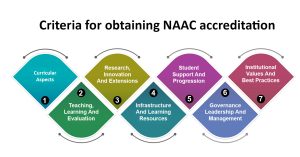
- Curricular Aspects: The design and implementation of academic programs, ensuring they are relevant, updated, and aligned with educational objectives.
- Teaching, Learning, and Evaluation: The methods, strategies, and assessment processes employed to facilitate effective learning experiences for students.
- Research, Innovation, and Extensions: Encouraging and fostering a culture of research, innovation, and community engagement beyond the traditional academic framework.
- Infrastructure and Learning Resources: The adequacy and effectiveness of physical and virtual facilities, ensuring a conducive environment for learning and research.
- Student Support and Progression: Initiatives and mechanisms in place to support students’ holistic development, ensuring their well-being and academic progression.
- Governance, Leadership, and Management: The effectiveness of institutional leadership, governance structures, and management practices in achieving the institution’s goals.
- Institutional Values & Best Practices: Institutions’ commitment towards opting for ethical practices and creating transparency to create a sustainable environment.
How can opting for sustainable solutions help you?
Obtaining the NAAC accreditation is not just about providing quality education to the students. It’s about how you can create an environment where they can thrive. It’s about adopting sustainable practices to create a safe environment for them. Under the 7th criterion following sub-criteria highlight the importance of adopting sustainable practices:
- The Institution has facilities for alternate sources of energy and energy conservation measures
- Environmental Consciousness and Sustainability
- Water conservation facilities are available in the Institution
- Green campus initiatives
These criteria by the NAAC highlights the need for adopting sustainable practices in an institution to create a sustainable environment for the students. Taking environmentally conscious measures helps institutes to score better during the accreditation.
How We at Koshish Sustainable Solutions Can Help You
Koshish is a sustainability-driven organisation, our team consists of experienced IITians with over 10 years of collective experience in the field of providing sustainable solutions to help organisations and individuals move towards a sustainable future.
We provide sustainable and eco-conscious solutions like Alternative Energy Source – Biogas plants, Recyle and reuse of water – Sewage Treatment Plants, and Water Conservation Technology – Flush Free Mens Urinal Kit.
Let’s understand how our solutions can contribute to fulfilling the criteria
- The Institution has facilities for alternate sources of energy and energy conservation measures: Implementing biogas plants introduces an alternative and renewable source of energy on the campus. By converting organic waste into biogas, institutions can significantly reduce their reliance on conventional energy sources, contributing to a more sustainable and eco-friendly campus.
- Environmental Consciousness and Sustainability: The introduction of biogas plants, waterless urinals, and sewage treatment plants reflects a strong commitment to environmental consciousness and sustainability. These solutions actively contribute to waste reduction, water conservation, and the overall ecological balance of the campus.
- Water conservation facilities available in the Institution: Waterless urinals or waterless urinal kits play a crucial role in water conservation. By eliminating the need for flushing, these urinals significantly reduce water consumption on campus. This aligns perfectly with the water conservation criteria, showcasing the institution’s dedication to responsible resource management.
- Green campus initiatives: The implementation of biogas plants, waterless urinals, and sewage treatment plants collectively contributes to the establishment of a green campus. These eco-conscious initiatives promote sustainable practices within the institute and reduce the environmental impact of the institute. This also encourages a culture of environmental responsibility among students and staff.
By addressing these specific NAAC criteria, Koshish’s sustainable solutions not only contribute to the institution’s accreditation but also showcase a proactive approach to creating environmentally conscious and resource-efficient campuses.
Bennett’s journey to achieving the NAAC Accreditation
In order to promote sustainable practices at their campus, Bennett University, Noida, recently installed a 2 cubic meter GreenHome Flexi Biogas Plant, from Koshish Sustainable Solutions, The plant is being used to transform the food waste from their canteen into biogas for cooking, which is a clean and renewable energy source.
This initiative addresses the 7th criterion of NAAC (Environmental Consciousness and Sustainability), showcasing the university’s commitment to environmental responsibility. The biogas plant plays a crucial role in reducing the reliance on conventional energy sources, which aligns with the university’s dedication to eco-friendly practices.
This proactive approach not only increased the university’s NAAC ratings, but also signifies their responsibility and forward-thinking attitude towards campus sustainability.
Final Thoughts
In the journey towards NAAC accreditation, every initiative matters. The installation of biogas plants and the adoption of Flush Free Urinals are not just green check boxes; they are strategic moves that align with NAAC criteria.
By embracing sustainability, educational institutions not only contribute to a healthier planet but also position themselves as leaders in the field of academic excellence. The NAAC accreditation process involves self-assessment, data submission, and peer review to ensure educational quality.
In the pursuit of knowledge, let sustainability be your guiding principle, and watch as your institution not only achieves accreditation but also becomes a leader in responsible education in the eyes of future generations.
Frequently Asked Questions (FAQs)
Question: What is NAAC Accreditation?
Answer: NAAC Accreditation is a quality assessment given to higher education institutes in India. It evaluates how well an institute provides education, develops students’ skills, and maintains a sustainable, student-friendly environment.
Question: Why is NAAC Accreditation important?
Answer: NAAC Accreditation plays an important role in improving the overall quality and reputation of higher education institutions in India. It builds trust that assures students, parents, faculty, and stakeholders about the quality of education provided. Institutions with NAAC Accreditation are seen as credible, progressive, and committed to academic excellence.
Question: How Does Installing a Biogas Plant Support NAAC Goals?
Answer: A biogas plant turns food or organic waste into renewable energy. It reduces dependence on conventional energy and showcases the institute’s commitment to sustainability.
A biogas plant converts organic waste, like food leftovers or garden waste, into biogas a clean, renewable source of energy. This biogas can be used for cooking, heating, or generating electricity. It reduces reliance on non-renewable energy and highlights the institution’s commitment to environmental protection.
Question: What role did Bennett University play in sustainability?
Answer: Bennett University installed a biogas plant to convert canteen waste into clean energy, supporting NAAC’s sustainability goals and improving their overall accreditation rating.
Bennett University has taken strong steps to make its campus more eco-friendly. One of the best examples is the installation of a biogas plant.