

Poultry biogas plant design is important because poultry farms produce a large amount of waste every day. Further, if this waste is not managed properly, it can cause bad smells, attract flies, pollute water, and harm the environment. However, a biogas plant is a simple solution that converts poultry waste into clean biogas for energy and organic fertiliser. Therefore, this helps farmers manage waste, reduce costs, and keep their farms cleaner.
As a result, you will learn about different biogas plant designs, key planning factors, space requirements, and how to choose the right system for your farm.

Therefore, choose the system based on your farm size and budget.
Therefore, if possible, keep extra space for future expansion.
What Is Poultry Biogas Plant Design?
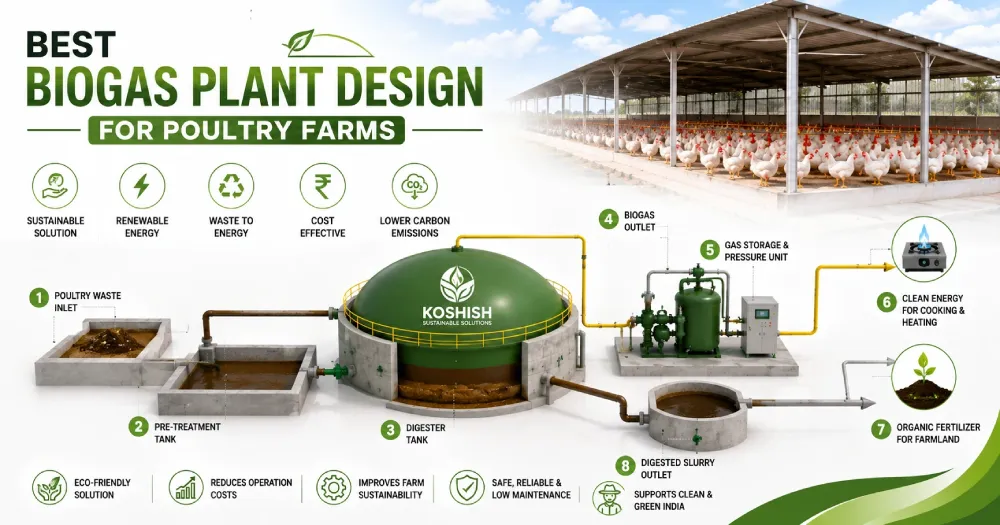
A poultry biogas plant design is the plan for building a system that converts poultry waste into biogas through anaerobic digestion. However, it includes the digester, waste feeding system, gas storage, slurry outlet, and plant layout. A good design helps to:- First, it produces more biogas
- Secondly, it manages waste properly
- Third, it reduces maintenance
- Fourth, it improves safety
- Lastly, it allows future expansion
Why Is a Good Poultry Biogas Plant Design Important?
Every poultry farm produces a different amount of waste. Therefore, every farm needs a design that suits its size. A good design helps to:- First, produce more clean energy
- Then, reduce bad smells and flies
- After that, lower fuel costs
- Moreover, make organic fertiliser
- Furthermore, increase plant life
- And lastly, improve daily operations
Types of Poultry Biogas Plant Design
There are three common types of biogas plants for poultry farms.- Fixed Dome Biogas Plant: A fixed dome plant has an underground concrete digester with a fixed roof. Therefore, the advantages are as follows:
- First, low maintenance
- Then, Long life
- After that, strong and durable
- Lastly, good for small and medium farms
- First, gas pressure changes during use
- And second, needs skilled construction
- Floating Drum Biogas Plant: This design has a drum that floats on the slurry and stores biogas. Therefore, the advantages of a floating drum biogas plant are as follows:
- First, steady gas pressure
- Then, easy to operate
- Lastly, gas level is easy to see
- More maintenance
- Metal drums may rust
- Higher maintenance cost
- Continuous Stirred Tank Reactor (CSTR): A Continuous Stirred Tank Reactor (CSTR) continuously mixes poultry waste inside the digester. However, this anaerobic digester poultry system is mostly used on medium and large poultry farms. Therefore, the advantages are as follows:
- First, high biogas production
- Then, better mixing
- After that, faster digestion
- And finally, suitable for large farms
Drawbacks
- First, higher installation cost
- Second, needs electricity
- Lastly, requires trained operators
Comparison of Biogas Plant Types
| Feature | Fixed Dome | Floating Drum | CSTR |
| Cost | Low | Medium | High |
| Maintenance | Low | Medium | Medium |
| Gas pressure | Changes | Stable | Stable |
| Best For | Small farms | Medium Farms | Large farms |
| Biogas Output | Moderate | Moderate | High |
Important poultry biogas plant design Factors
A successful digester design poultry waste project depends on proper planning. Daily Waste: Know how much poultry waste your farm produces every day. This helps decide:- Digester size
- Gas production
- Slurry storage
- Safety valves
- Pressure release system
- Gas leak detection
- Good ventilation
Plant Layout for Poultry Biogas Systems
A good plant layout poultry makes the system easy to operate. Therefore, most plants include:- Waste collection area
- Mixing tank
- Anaerobic digester
- Gas storage
- Biogas pipeline
- Slurry outlet
- Fertilizer storage
Space Requirements
The required land depends on the size of the farm.| Farm Size | Space Needed |
| Small Farm | 150-300 sq.m. |
| Medium Farm | 300-700 sq. m. |
| Large Farm | 700-2,000+ sq.m. |
Planning for Future Growth
Many poultry farms grow over time. However, a biogas system poultry farm should be designed so it can be expanded later. Therefore, future upgrades may include:- First, bigger digesters
- Then, more gas storage
- After that, extra slurry tanks
- Electricity generation
- Bio-CNG production
Common Mistakes to Avoid In Poultry Biogas Plant Design
Avoid these common mistakes in poultry biogas plant design:- First, choosing the wrong digester size
- Second, not calculating daily waste
- Third, poor slurry mixing
- Fourth, no space for expansion
- Fifth, ignoring safety
- Lastly, poor pipeline design
Benefits of a Good Poultry Biogas Plant Design
A well-designed plant offers many benefits:- First, better waste management
- Second, lower energy costs
- Third, clean renewable energy
- Fourth, less greenhouse gas emissions
- Fifth, reduces bad smells
- Sixth, organic fertilizer production
- Finally, more sustainable farming