
Everyone might be aware of the procedure for producing biogas from cow dung, poultry litter, agricultural residues, and municipal waste. Further compression of biogas produces CBG, which is the best alternative to fuels and natural gas. Now, the two gases have different uses. Biogas vs CBG gas: Which one is more efficient, how is it operated, and what is the cost of the plants?
We will discuss everything important about Biogas & Compressed Biogas Plants in this blog.
The key technical difference lies in biogas upgrading, where CO₂, H₂S, and moisture are removed using technologies like water scrubbing, PSA, or membrane separation. This purification significantly improves fuel quality.
What is Biogas?
Biogas is a renewable fuel produced through anaerobic digestion of organic waste such as agricultural residues, food waste, sewage sludge, and animal manure. The raw biogas composition typically includes:- Methane (CH₄): 50–65%
- Carbon dioxide (CO₂): 30–45%
- Traces: Hydrogen sulfide , moisture, ammonia
What Is Compressed Biogas (CBG)?
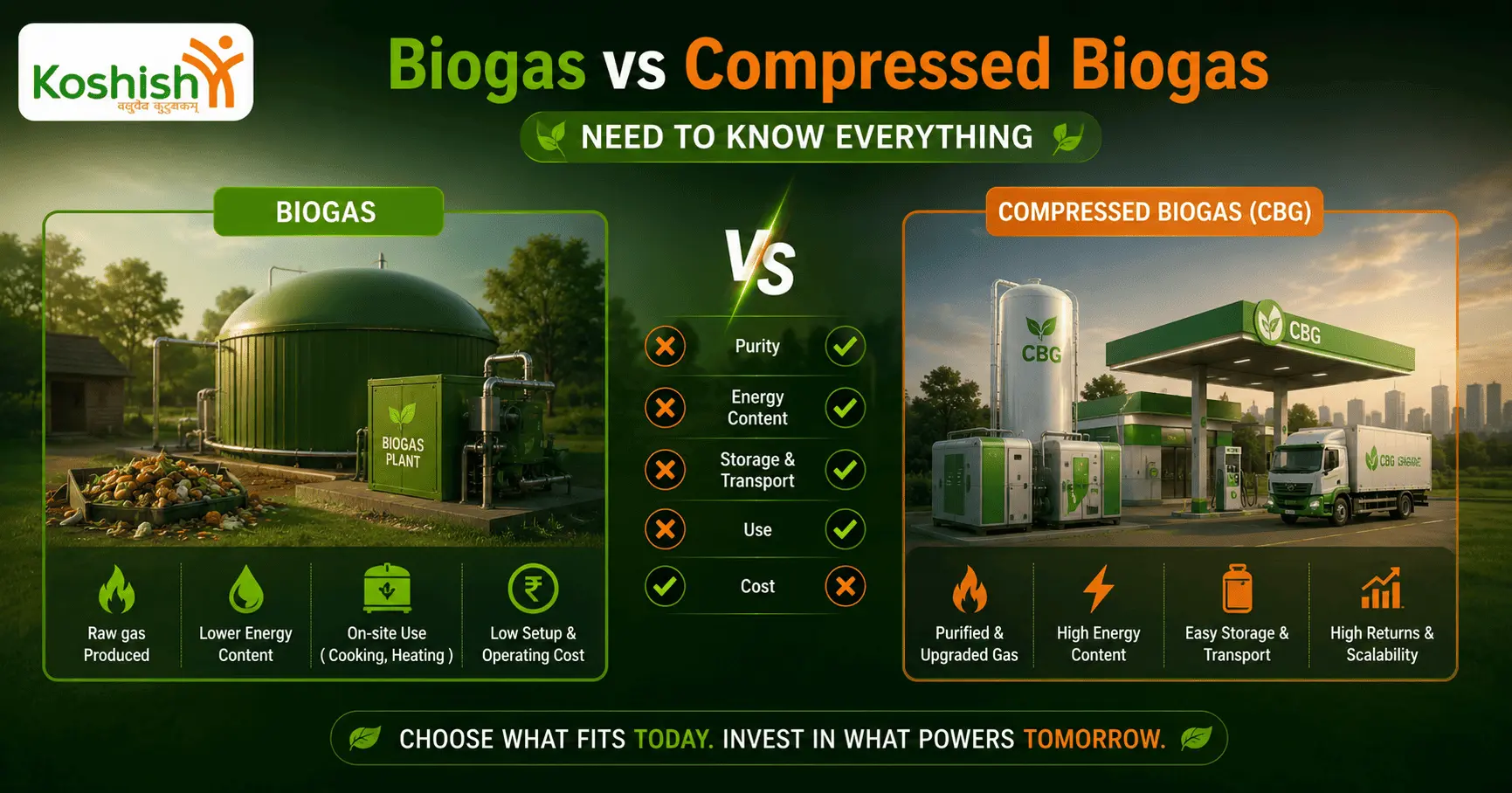
Compressed Biogas (CBG) is an advanced form of biogas produced after biogas purification, upgrading, and compression. Once purified, the methane content increases to 90–98%, making it comparable to CNG (Compressed Natural Gas). CBG is compressed to 200–250 bar, allowing it to be stored in cylinders and transported for commercial and vehicular use. In India, CBG plays a major role under the SATAT (Sustainable Alternative Towards Affordable Transportation) initiative.Technical Differences Between Biogas and CBG Gas
| Basis Of Distinction | Biogas | Compressed Biogas |
| Methane Content | 90% | 95%-98% |
| Processing Level | Basic digestion | Advanced upgrading & compression |
| Impurities | CO₂, H₂S, moisture | Mostly removed |
| Pressure | Atmospheric | 200–250 bar |
| Energy Efficiency | Moderate | High |
Biogas Upgrading and Purification
Biogas purification is essential when converting biogas into CBG. The upgrading process focuses on:- Removing CO₂ to increase methane concentration
- Eliminating H₂S to prevent corrosion
- Moisture removal for safe compression
- Pressure Swing Adsorption (PSA)
- Water Scrubbing
- Chemical Scrubbing
- Membrane Separation
CBG Compression: Why It Matters
After purification, biogas undergoes CBG compression to increase energy density. Compression:- Reduces volume drastically
- Enables cylinder storage and transportation
- Makes CBG compatible with CNG infrastructure
Storage and Transport Comparison
Biogas- Stored in low-pressure gas holders or balloons
- Cannot be transported economically
- Best suited for on-site consumption
- Stored in high-pressure cylinders
- Easily transported via cascade systems
- Can be injected into gas grids or sold to OMCs
Usage Comparison
Biogas Applications- Cooking fuel in rural and institutional kitchens
- Electricity generation through biogas engines
- Thermal energy for boilers
- Automotive fuel (replacing CNG)
- Industrial heating and furnaces
- Commercial fuel supply through gas networks
CBG Energy Density: A Major Advantage
One of the biggest advantages of CBG is its high energy density.- Biogas: ~20–23 MJ/m³
- CBG: ~52–55 MJ/kg (similar to CNG)
- More power per unit volume can be generated through the CBG Cas
- Lower transportation cost per energy unit than vehicles running on natural gases
- It offers better fuel efficiency than natural gas for vehicles.
Cost Comparison: Biogas vs CBG
There are a few direct distinctions between biogas Vs CBG gas, which are stated below: Biogas- There is lower capital investment
- There is minimal purification cost
- Limited revenue potential
- Best for captive consumption
- Higher initial investment due to upgrading & compression
- Eligible for government incentives and OMC offtake
- Higher long-term returns
- Commercially scalable
Which One Should You Choose?
The choice depends on scale, budget, and intended usage. Below are the options and reasons for which the plants are used:- Biogas is a good option if your goal is local energy use, waste management, or rural cooking fuel.
- CBG if you want commercial fuel production, transportation applications, or long-term profitability.
Wrapping Up
The debate of biogas vs CBG is not about which is better, but which is more suitable for a specific application. In general, the use of Biogas and compressed biogas (CBG). Biogas offers a simple, cost-effective solution for on-site energy needs, while CBG, through biogas upgrading, purification, and compression, unlocks higher energy density, transportability, and commercial value. With India’s growing focus on clean energy and circular economy models, CBG is emerging as the future-ready biofuel, while biogas continues to play a vital role in decentralised energy systemsFrequently Asked Questions (FAQ)
Is CBG better than biogas?
CBG is superior in energy density, storage, transport, and commercial use, but biogas is more economical for small-scale, local use.
Why is biogas upgrading necessary for CBG?
Upgrading removes CO₂, H₂S, and moisture, increasing methane purity and making compression safe and efficient.
Can biogas be directly compressed?
No. Raw biogas must be purified before CBG compression to prevent equipment damage and safety issues.
Is CBG the same as CNG?
CBG is a renewable alternative to CNG, with properties similar to those of CNG but derived from organic waste rather than fossil fuels.
What is the biggest advantage of CBG?
High CBG energy density, easy transport, and compatibility with existing gas infrastructure.