
Converting agricultural waste to biogas is a smart way to solve a big problem on farms. Every year, farmers have a lot of crop waste after harvesting. Many burn this waste because they do not know what else to do. As a result, the air becomes dirty, the soil becomes weak, and people face health problems. However, there is a better way. Farmers can turn this agricultural waste to biogas and organic fertilizer.
 Therefore, they can keep their farms clean, save money, and earn extra income.
In this guide, you will learn what agricultural waste to biogas is, which farm waste can be used, how to collect and store it, why the government supports it, and how much energy it can produce.
Therefore, they can keep their farms clean, save money, and earn extra income.
In this guide, you will learn what agricultural waste to biogas is, which farm waste can be used, how to collect and store it, why the government supports it, and how much energy it can produce.
Therefore, they can keep their farms clean, save money, and earn extra income.
In this guide, you will learn what agricultural waste to biogas is, which farm waste can be used, how to collect and store it, why the government supports it, and how much energy it can produce.
What is Agricultural Waste to Biogas?
Agricultural waste to biogas means making clean energy from farm waste. Tiny bacteria break down the waste inside a closed tank without oxygen. This process makes biogas. The biogas can be used for multiple purposes:- Cooking
- Making electricity
- Heating
- Making Bio-CNG
Types of Agricultural Waste
There are various types of agricultural waste that get converted to biogas energy. Below are the following:- Rice straw
- Wheat straw
- Maize stalks
- Sugarcane leaves
- Cotton stalks
- Corn cobs
- Vegetable waste
- Fruit waste
- Dry leaves
- Animal dung mixed with crop waste
Crop Residue Biogas
After harvesting, a lot of crop waste remains in the field. This leftover material is called crop residue. Many farmers burn it. However, burning creates smoke and pollutes the air. Instead, farmers can use these crop residues in a biogas plant. Common crop residues include rice straw, wheat straw, maize stalks, and sugarcane trash. As a result, farmers get clean fuel instead of pollution.Crop Residue Stubble to Renewable Energy
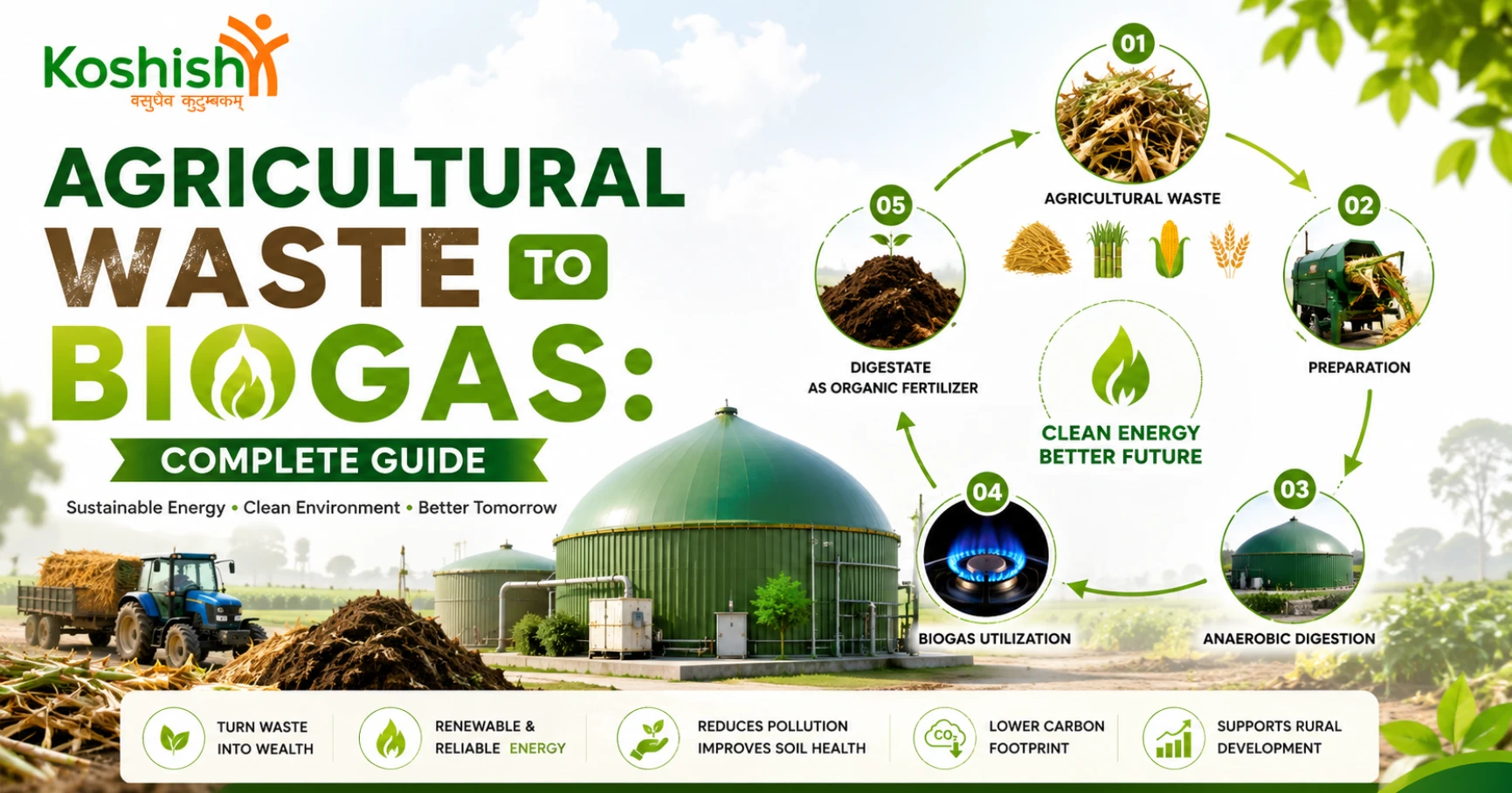
After crops are cut, small stalks remain in the field. These are called stubble. Many farmers burn stubble. As a result, the air becomes dirty, and the soil loses nutrients. However, stubble to energy is a better option. It is a huge opportunity for farmers to use this agricultural waste to Biogas production. The process is simple: Crop Stubble → Biogas Plant → Biogas/Bio-CNG + Organic Fertilizer Therefore, crop residue becomes useful for many other purposes rather than getting thrown away.Agricultural Farm Waste Management
Good farm waste management promotes cleanliness on the farm. If farm waste remains open:- First, bad odour increases
- After that, Insects grow on the farm
- Moreover, the pollution rate increases
- Lastly, the farm gets dirty, which creates hygiene issues
- First, due to the farm waste management process, cleanliness and hygiene are promoted
- Secondly, the production of clean and renewable energy becomes easier and more prominent
- Thirdly, after the anaerobic digestion process, the leftover is organic fertiliser, which is used for crops
- Lastly, it lowers GHG emissions, which means less pollution
How to Collect and Convert Agricultural Waste to Biogas
Proper collection and farm waste management help in producing crop residue biogas in bulk. However, farmers first need to collect the agricultural waste after harvesting; second, they need to remove all plastic and stones from the harvest. After that, the farmers need to cut large pieces into small ones, and lastly, take all the agricultural waste to biogas plant for the production of renewable energy. Therefore, the plant works better.How to Store Agricultural Farm Waste
Proper storage of crop residue biogas is also important. First, keep it in a dry place. Secondly, cover it from rain. Thirdly, store it in an airtight container or place it neatly. Use it before it starts rotting. As a result, higher-quality biogas is produced.How an Agri biogas Plant Works
An agri biogas Plant works with simple steps:- First, collection of the agricultural waste.
- Then, the agricultural waste is cut into small pieces, and a mixture with water is prepared.
- After that, the mixture is put in the digester where the anaerobic digestion process takes place.
- After 14 days the mixture emits methane gas that is further collected in cylinders.
- Lastly, the leftover waste is used as bioslurry and solid fertiliser.
Government Support for Stubble Burning Solution
The government of India wants to reduce stubble burning and turn the agricultural waste to biogas. Therefore, it encourages farmers to use biogas plants. The government supports:- Crop residue management
- Biogas projects
- Clean energy
- Better farming
Yield Potential from Agricultural Waste
Agricultural waste can produce a large amount of biogas. Different crops produce different amounts of gas. Usually, dry crop waste like rice straw and wheat straw gives good results after proper treatment. In addition, mixing crop waste with animal dung helps produce more biogas. Therefore, farmers can make better use of farm waste instead of throwing it away.Advantages of Agricultural Waste to Biogas
There are many advantages of making agricultural waste to biogas.- Reduces stubble burning to ashes
- Lowers air pollution
- Produces clean energy from agricultural waste
- Makes organic fertiliser
- Reduces agricultural farm waste
- Improves soil health
- Lowers the cost
- Gives extra income by selling the bio-slurry
- Supports clean farming
Challenges Faced Due to Improper Farm Waste Management
Various challenges can arise from improper farm waste management. Some problems can happen. They are as follows:- First, crop waste is available only after harvest.
- Then, transporting waste costs money.
- After that, some waste needs cutting before use.
- Lastly, a biogas plant needs investment.