
With the growing awareness about sustainability in India, a highly debated yet interesting topic has arisen: Biogas vs LPG for industries. This shift is prompted by the traditional reliance on fueling cooking gases with kerosene, coal, and other fuels, as well as the potential of biogas. Both gases have their own characteristics that make them different from each other. Usually, people get perplexed with the two and hold on to the one with more potential in the long term.
Several factors are compared between the two, including safety advantages, carbon footprint reduction, and cost comparisons between LPG and biogas. We’ll find out which is better in the blog below; keep scrolling!
Why Large-Scale Kitchens Depend on LPG?
LPG is known for its affordable pricing, as the government provides a significant subsidy on it, which makes it easily accessible for middle-class households. Even without the subsidy, the prices are highly competitive compared to those of Kerosene and coal. An LPG Gas Cylinder is used for at least 35-40 days, depending on the family’s usage. Refilling it would not be an issue since it will be eliminated from the process for quite a while. For places that use LPG Gas Cylinders in bulk, such as restaurants & hotels, the cylinders are sold at very competitive prices in the market. In this comparison of Biogas vs LPG for industries, it is especially relevant when evaluating factors such as safety, cost-effectiveness, and long-term sustainability.
How are LPG Cylinders convenient for Daily Life?
Unlike inductions, there is no issue of power cuts and electricity bills. A very convenient service is provided for doorstep delivery of LPG cylinders. This service helps families avoid running out of cooking fuel at home unexpectedly.
There is one more benefit of installing LPG: unlike a piped installation, LPG does not need to be fixed in one place; it can be picked up and kept anywhere the person wants. It is the best solution for people living on a budget, in small kitchens, and in food stalls on roads, where flexibility matters the most.
Why Biogas is a Sustainable Alternative?
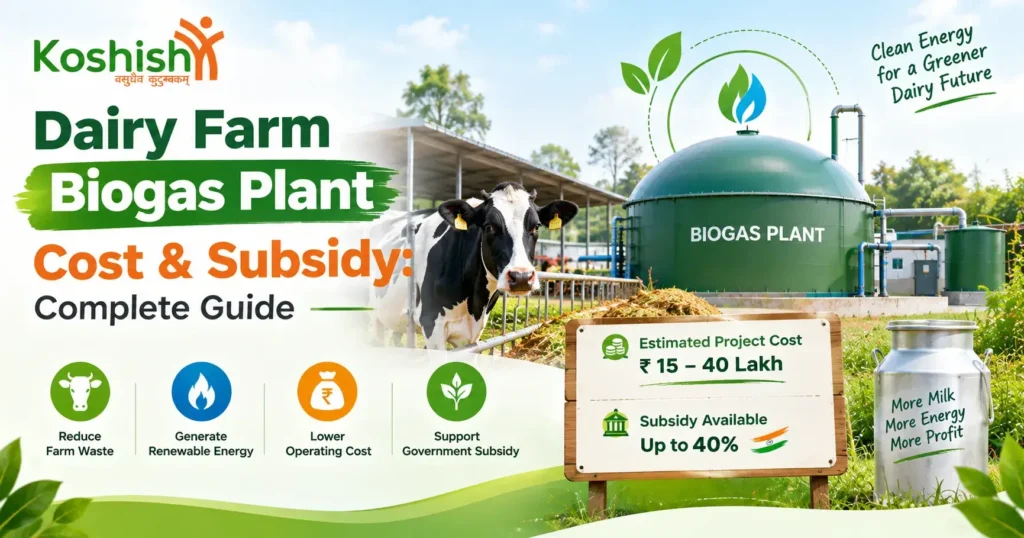
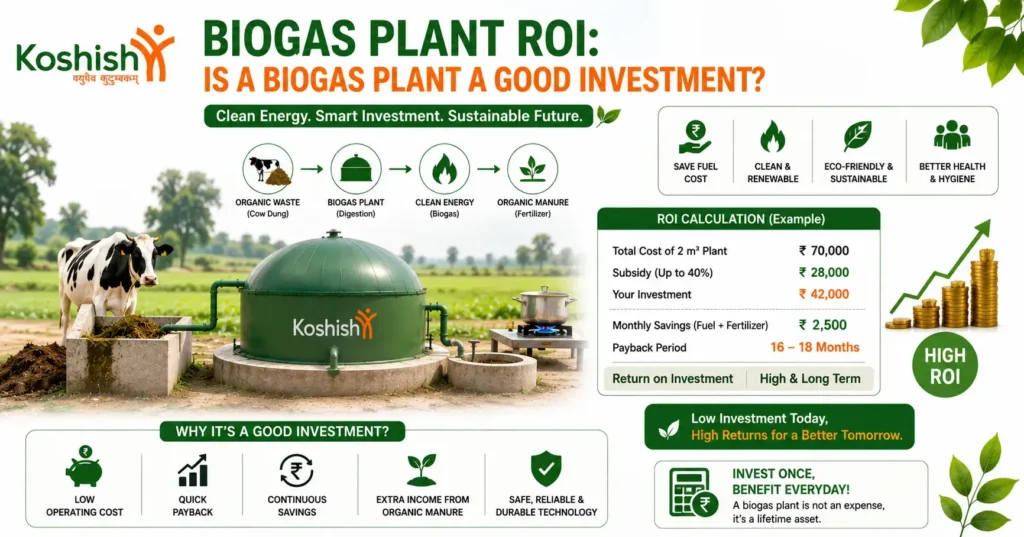
When we evaluate Biogas vs LPG for Industries, Biogas is considered the best sustainable alternative because it’s a renewable source of energy extracted from organic waste, including kitchen waste, cow dung, and poultry litter. It reduces greenhouse gases, preventing methane gas from being emitted into the environment. The Primary Cost comparison between LPG and biogas is that LPG is significantly cheaper. On the other hand, Biogas provides a source of income by producing biofertilizer from the remaining material. It helps the circular economy by providing energy and a source of income for the rural region.
What are the economic, social, and environmental benefits of Biogas?
The debate of Biogas vs LPG for Industries is not only about cost, but also about the larger social and Environmental benefits that Biogas brings to the Rural Areas, which are as follows:
- The Greenhouse Gases are reduced since Biogas is a renewable energy source.
- Through the Biogas Plant, organic waste is utilised, enabling effective waste management.
- The digestate, a byproduct of biogas, serves as a Biofertilizer in the fields, thereby eliminating the need for chemical fertilisers.
- Through Biogas, the air quality is also improved since it replaces traditional biomass fuels.
The Economic & Social benefits of Biogas are as follows:
- The dependency on fossil fuels is reduced since it provides a source of renewable energy.
- This creates jobs and income opportunities for the rural people.
- The production of Biogas depends on the local availability of organic material, which gives a stable & affordable energy cost for consumers.
- After generating Biogas, it undergoes further processing to produce CBG Gas (Compressed Biogas), an alternative to petrol and CNG. This clean gas is more affordable than Compressed Natural Gas (CNG).
Challenges & Solutions Of Biogas
The Challenges faced by people through the Biogas Plant are as follows:
Installation Cost: The cost of building a Biogas Plant is significantly higher than purchasing LPG.
Requirement of Space: Many farmers lack the necessary space to build a Biogas Plant, despite generating large amounts of organic waste. This makes daily processing a challenge due to the plant’s inadequate size.
Maintenance: The Biogas Plant requires regular monitoring and feedstock management, which can be hectic for the farmer due to various operational challenges
The Solutions through the Biogas Plant are as follows:
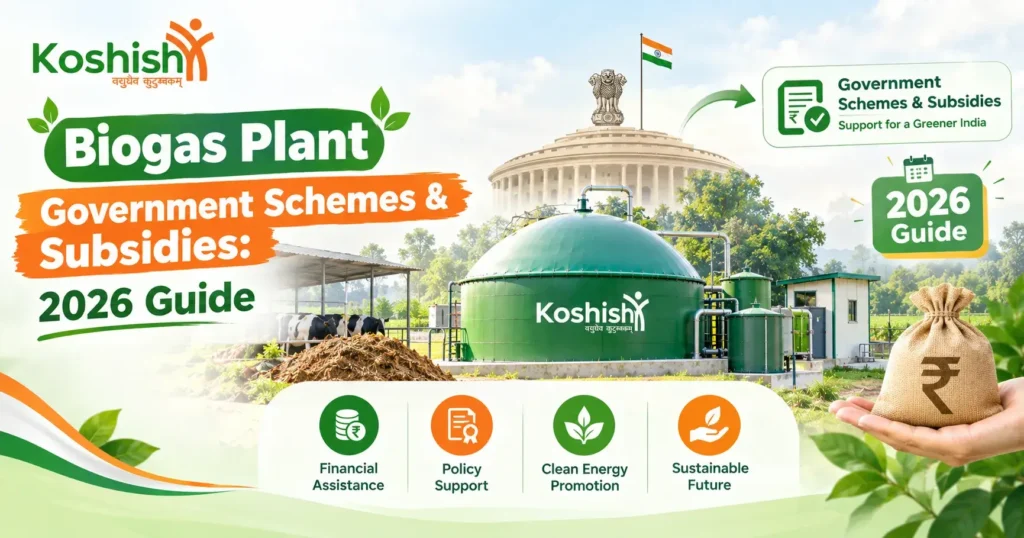
- Subsidies & Incentives: The Government provides several subsidies to alleviate the high installation costs of the Biogas Plant.
- Modular and compact biogas plant designs are now available, which can be scaled up based on demand and require less footprint.
- Specialised companies provide operation & Maintenance (O&M) services. These services ensure smooth functioning, efficiency, and long-term reliability of the system without burdening the kitchen staff.
Future of Biogas in Commercial Kitchens
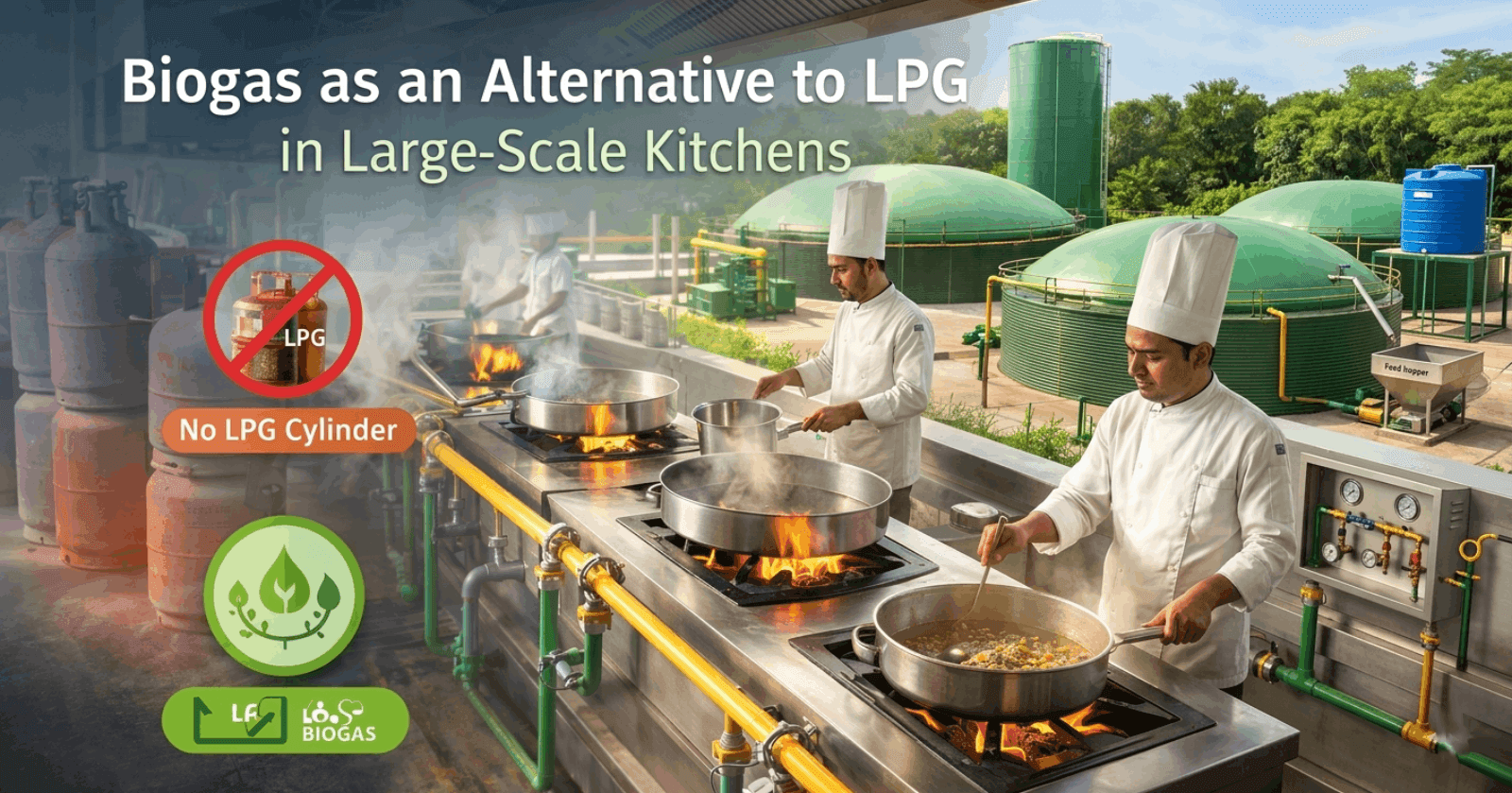
The discussion about Biogas Vs LPG for Industries will shape how commercial kitchens operate, as well as Hotels and institutions transition towards greener energy sources. The future of biogas in large-scale commercial kitchens is auspicious, fueled by the global and national push toward renewable energy. Governments are increasingly supporting clean energy initiatives through subsidies, tax benefits, and awareness programs, making biogas adoption more practical than ever. In sectors such as hospitality, education, and healthcare, where energy demand is continuous, biogas offers not just cost savings but also a strong sustainability advantage. Hotels, hostels, schools, and hospitals are beginning to view biogas as a dependable and eco-friendly alternative to LPG.
Moreover, as organizations align with net-zero targets and ESG (Environmental, Social, and Governance) commitments, biogas plays a pivotal role in reducing carbon footprints while promoting waste-to-energy models. This positions biogas not merely as a fuel substitute but as an enabler of sustainable growth.
Conclusion
Biogas stands out as a practical, sustainable, and economically viable alternative to LPG in large-scale kitchens. It addresses rising fuel costs, reduces dependency on fossil fuels, and supports waste management while significantly cutting down carbon emissions. With increasing government support, modular plant designs, and professional maintenance services, the barriers to adoption are steadily reducing. For institutions committed to efficiency and sustainability, investing in biogas is no longer just an option; it is a forward-looking necessity that aligns with both financial and environmental goals.