
What is the biogas subsidy 2026?
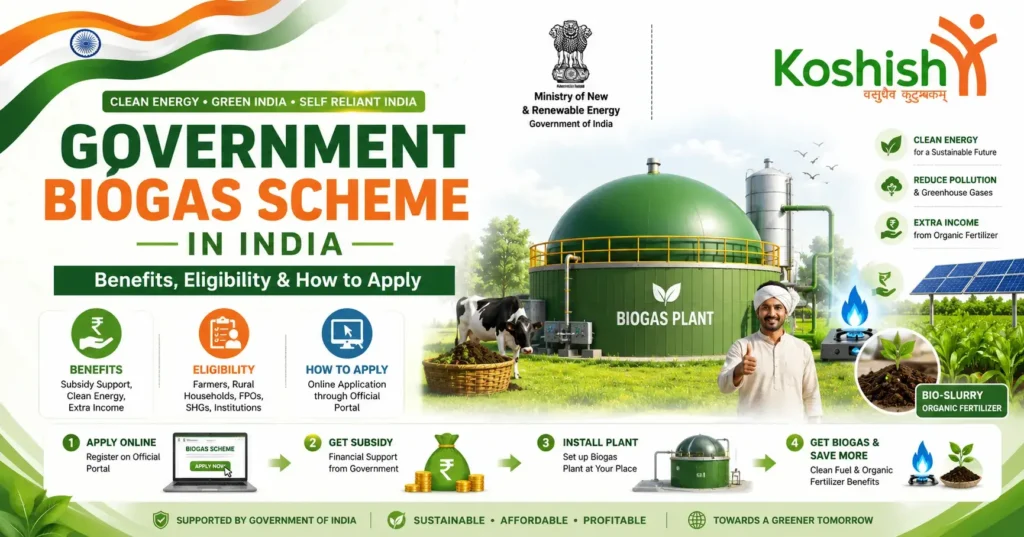
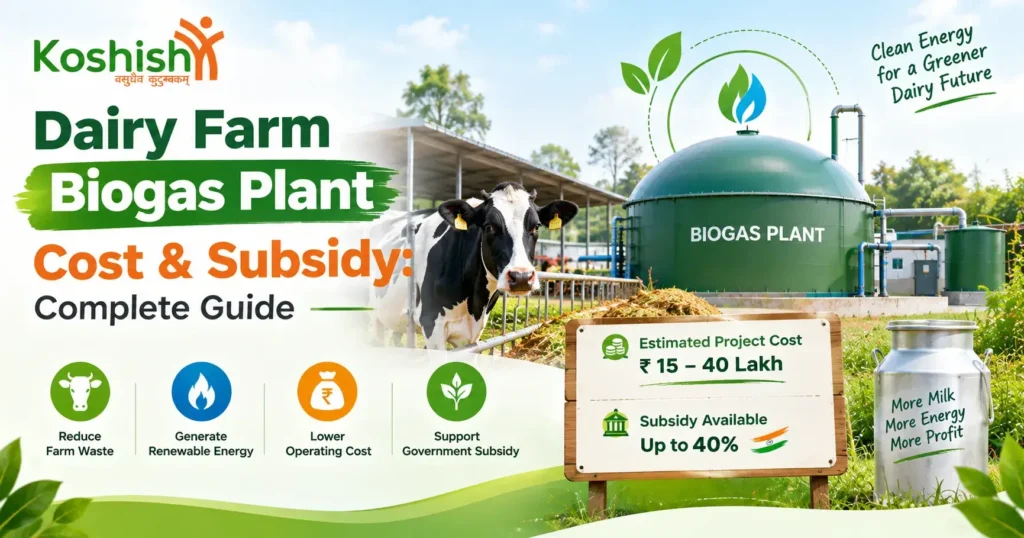
The Government of India initiates this biogas subsidy 2026 financial support, which is available under the MNRE’s biogas program. The latest officially published program covers FY 2021–22 to 2025–26. Therefore, applicants should verify the current scheme period and availability before starting a new project in 2026. The official MNRE Biogas Application Portal remains active in 2026. The program supports small biogas plants of 1–25 cubic metres per day and medium biogas plants above 25 up to 2,500 cubic metres per day. The assistance depends on plant capacity, location, and beneficiary category.How Much Is the MNRE Biogas Subsidy?
Under the latest published MNRE guidelines, CFA for small plants ranges from ₹9,800 to ₹70,400 per plant, depending on capacity and beneficiary category. For specified hilly and northeastern states, islands, and SC/ST beneficiaries, the applicable assistance can be higher. The eligible biogas plants that are linked with sanitary toilets or an MNRE-approved slurry filter unit can also receive an additional fixed subsidy of ₹1,600, subject to the applicable conditions.Who Can Apply for Government Subsidy for a Biogas Plant?
The biogas plant eligibility depends on the plant size and program requirements. For small plants, beneficiaries generally need suitable land or space of around 50–60 square meters, a regular supply of cow dung or other suitable feedstock, water availability, and the financial ability to contribute their own share. Farmers, dairy owners, rural households, and eligible community or institutional users can therefore explore the program through the designated implementing agencies.What About Medium Biogas Plants?
The latest biogas scheme and subsidies also covers medium plants above 25 to 2,500 m³/day. For eligible power-generation projects, the published CFA ranges from ₹35,000 to ₹45,000 per kW, depending on capacity. This can make the program relevant to larger dairy, agricultural, and institutional projects. However, commercial applicants should check the latest MNRE notification before assuming that a particular project qualifies for financial assistance.How to Apply for the MNRE Biogas Subsidy 2026?
The procedure for procuring the government subsidy for biogas plants is simple for small biogas plants; beneficiaries can submit applications through the MNRE Biogas Application Portal. The implementing agency processes applications after target allocation and takes further action for installation. Medium-sized projects follow a separate proposal process through the program’s implementing agencies. The official portal provides registration, application forms, program documents, and information about State Program Implementing Agencies. Importantly, the CFA is generally linked to successful construction and commissioning rather than simply being an upfront discount on the plant price. Therefore, applicants should understand the reimbursement and verification requirements before beginning construction.Is the Biogas Scheme 2026 Still Available?
This is an important question for anyone planning an investment in 2026. The latest official MNRE material currently identifies the Biogas Program Phase-I period as FY 2021–22 to 2025–26. The National Bioenergy Program also had a Phase-I outlay of ₹858 crore. At the same time, the official Biogas Application Portal is active and carries 2026 copyright information. Therefore, applicants should not rely on old articles claiming a new 2026 subsidy amount. Instead, they should verify the latest notification, application status, and availability with MNRE or the relevant State Programme Implementing Agency.Wrapping Up
The biogas subsidy 2026 can help reduce the financial burden of eligible biogas projects while supporting clean energy, waste management, and organic manure production. The latest published MNRE provisions provide CFA based on plant capacity and beneficiary category, with additional support available for certain eligible components. Before investing, check the latest official MNRE guidelines, confirm your eligibility, and speak with the relevant implementing agency. This is especially important in 2026 because the currently published program period runs through FY 2025–26, and scheme provisions may change with a new program or notification.Frequently Asked Questions (FAQ)
What government schemes are available for biogas plants in India in 2026?
On a general note, there are various government measures that assist biogas and bioenergy projects in India. Firstly, there is the Government’s Biogas Programme, which has been assisted by the MNRE. Secondly, there is the GOBARdhan initiative that helps in converting organic waste to biogas, bio-CNG, among others. Moreover, the GOBARdhan scheme has been extended recently to promote CBG production.
Does the government provide a subsidy for setting up a biogas plant?
Indeed, there could be some government aid that can be availed in terms of subsidy if one qualifies under their program. It is important to note that the subsidy is determined by several factors including the capacity of the plant, technology used, kind of waste, site of installation, and the class of beneficiaries. For instance, MNRE’s Biogas Program offers CFA for some qualifying biogas plants.
How much subsidy can I get for a biogas plant in 2026?
This will depend on the project. For example, as per the MNRE Biogas Scheme, CFA for small biogas plants may range between ₹9,800 and ₹70,400 per plant. In addition, more subsidy will be available in some categories such as in the North-Eastern Region, islands, gaushalas, and SC/ST categories. Thus, it is important to determine the exact subsidy based on the scheme and the project details.
Is there any government subsidy for commercial or industrial biogas plants?
Yes, it is possible for eligible commercial and industrial projects to be funded under the MNRE Waste-to-Energy Scheme. Eligible projects for the scheme are those that use urban, industrial, and agricultural waste to generate biogas, Bio-CNG/CBG, and electricity. Moreover, the scheme covers eligible projects involving waste streams like agricultural waste, cattle waste, poultry waste, and organic waste from industries. This means that eligible commercial projects must first determine their eligibility before funding.
What is the GOBARdhan scheme, and how does it support biogas projects?
GOBARdhan (Galvanizing Organic Bio-Agro Resources Dhan) is a program that seeks to make use of organic wastes through production of biogas and bio-slurry. Prior to this, the scheme had been oriented towards waste management at the village level and also toward biogas plants at the community level. However, more recently, the Union Cabinet has approved a much larger GOBARdhan program for a cost of ₹23,731 crore.