A 5kW residential solar solution installed for Rekha Pathak in Ghaziabad to power a sustainable home.

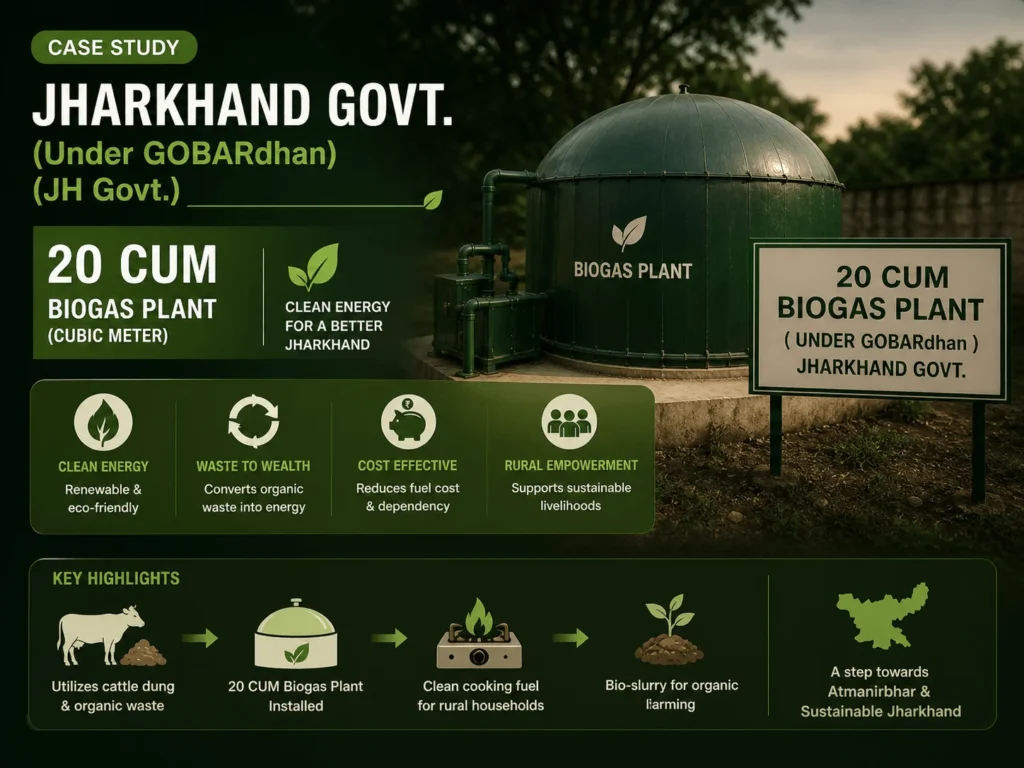
20 CUM Biogas plant-2 (Under GOBARdhan)
The Jharkhand government, under the GOBARdhan initiative, faced a growing challenge in Chota Belma Village, managing approximately 500 kg of cow dung waste daily. This unmanaged waste was contributing to rising carbon emissions, higher electricity expenses, and increasing fuel costs.
To address these issues, a commercial biogas plant of 20 CUM capacity was adopted. The solution was implemented to ensure efficient waste management while generating renewable energy and organic by-products. The project was initiated through trusted references and word of mouth, reinforcing confidence in proven sustainable technologies.
Turning Waste into Energy: Real Impact of the 20 CUM Biogas Project
Watch how the Jharkhand Govt’s GOBARdhan biogas plant transforms organic waste into clean energy. This project highlights sustainable innovation, rural empowerment, and an eco-friendly solution for a greener future.
Objectives
There are several problems that need to be taken care of with the help of Commercial Biogas Plant.
01.
To improve the waste management disposal system.
02.
To lower the carbon emissions and protect the environment.
03.
To provide clean energy for cooking and generating fuel.
04.
To cut costs in the electricity bills and fuel costs.
Challenges
Overcoming the issues that arise from not managing the cow dung efficiently and effectively.
Waste Disposal Problem
Without a proper waste disposal system, the waste gets piled up and causes many other issues.
Increase in Carbon Footprint
With the improper management of gobar waste, the release of methane increases the carbon emissions.
Increasing Energy Costs
Electricity and fuel expenses were continuously rising, impacting operational sustainability.
Impact
A Commercial Biogas Plant provides an immediate and eco-friendly solution to them.
Systematic Waste Disposal
The commercial biogas plant converts the cow dung waste into the methane gas, which is very useful.
Lower in Carbon Emissions
With the systematic disposal of cow dung, eventually no waste is piled up, and there is a direct decrease in carbon emissions.
Partial Cut in Energy Cost
There is a partial cut in the electricity bills and fuel costs.
Efficient Utilisation of Resources
The cow dung is converted into clean energy and gets utlise in many other ways.
Other case Studies
KOSHISH is an initiative by a team of young professionals from the Indian Institute of Technology.