
CBG feedstock selection is one of the most important decisions that sets the technical performance, financial viability, and long-term sustainability of Compressed Biogas (CBG) plants in India. With the Government of India promoting CBG through initiatives such as SATAT & Gobardhan Schemes, it must carefully assess feedstock availability, yield potential, and supply consistency before undertaking a project.
India has a diverse range of biomass resources, including animal and kitchen waste, making it well-positioned for CBG development. However, not all feedstocks deliver the same biogas yield or operational stability. This blog explores how to select the right feedstock mix for CBG plants in India, focusing on availability, yield optimisation, sustainability impact, and supply reliability.
Understanding CBG Feedstock in the Indian Context
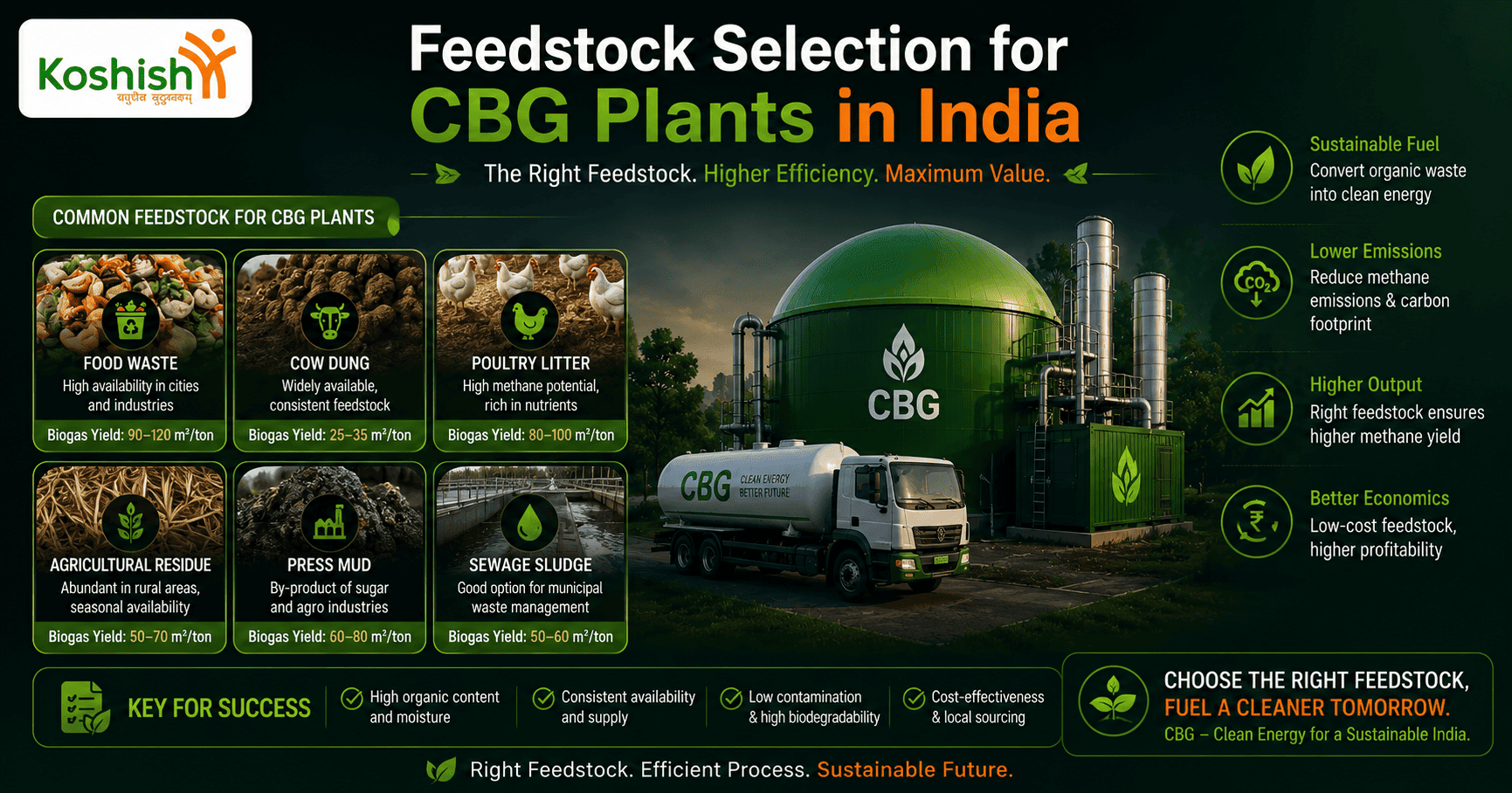
CBG feedstock is organic waste that rots naturally and is used to produce biogas, which is then converted into Compressed Biogas (CBG). An ideal feedstock should be:- Locally available in large quantities
- Cost-effective to collect and transport
- High in methane yield
- The feedstock should be available throughout the year
Feedstock Availability: Mapping Local Resources
Feedstock availability is the first checkpoint in CBG project planning. India generates millions of tonnes of biodegradable waste annually, but its spatial distribution varies significantly. Organic Waste for CBG: Urban and semi-urban regions generate large volumes of organic waste for CBG, including food waste, vegetable market waste, hotel waste, and food processing residues. Municipal solid waste (MSW) with high organic content can also be tapped through source segregation. Using organic waste for CBG not only ensures a steady feedstock supply near cities but also helps address waste management challenges faced by urban local bodies. Agricultural Waste Biogas: Rural India offers abundant crop residues such as straw, husk, stubble, press mud, and damaged grains. Agricultural waste biogas projects are especially viable in states like Punjab, Haryana, Uttar Pradesh, and Maharashtra, where farming activity is intense. However, agricultural residues are often seasonal and may require pre-treatment, such as shredding or slurry preparation, to improve digestion efficiency. Animal Waste CBG: India has one of the world’s largest livestock populations, making animal waste CBG a reliable and consistent feedstock option. Cattle dung, poultry litter, and dairy farm waste provide stable biogas yields due to their balanced nutrient content. Animal waste CBG projects are particularly suitable for dairy clusters, gaushalas, and integrated livestock farms where daily waste generation is predictable.Yield Optimisation: Choosing High-Performance Feedstock
Yield optimisation directly affects gas output and revenue. Not all feedstocks produce the same amount of methane per ton. High-Yield Feedstock Characteristics A high-yield feedstock typically has:- High volatile solids content
- Favourable carbon-to-nitrogen (C:N) ratio
- Low lignin concentration
- Easy biodegradability
Sustainability Impact of Feedstock Selection
Feedstock choice has a direct environmental and social impact. Sustainable CBG feedstock strategies contribute to the following:- Reduction in the open burning of crop residues
- Lower methane emissions from unmanaged waste
- Improved soil health through bio-slurry application
- Enhanced rural income through waste monetisation
Supply Consistency: Ensuring Year-Round Operations
One of the biggest operational risks for CBG plants is feedstock supply disruption. Supply consistency depends on:- Seasonality of waste generation
- Long-term feedstock contracts
- Storage and logistics infrastructure
- Store silage or biomass
- Blend with animal waste CBG for year-round input
- Source organic waste for CBG from nearby towns
Wrapping Up
Selecting the right CBG feedstock is the foundation of a successful and sustainable CBG project in India. While CBG using organic waste for high yields near urban centres offers strong opportunities, CBG using agricultural and animal waste provides strong rural opportunities when managed efficiently. Prioritising high-yield feedstock, ensuring local availability, and planning for supply consistency can significantly improve plant performance and financial returns. As India accelerates its clean energy transition, strategic feedstock selection will be key to scaling up CBG production while delivering environmental, economic, and social benefits.Frequently Asked Questions (FAQ)
What is the best CBG feedstock in India?
There is no single best feedstock. A mix of organic waste for CBG, animal waste CBG, and agricultural residues is often ideal for stable operations and higher yields.
Why is high yield feedstock important for CBG plants?
High yield feedstock produces more methane per tonne, improving gas output, reducing operating costs, and enhancing plant profitability.
Is agricultural waste biogas viable throughout the year?
Agricultural waste biogas can be seasonal. Co-digestion with animal waste, CBG, or stored biomass helps maintain a year-round supply.
How does feedstock selection impact sustainability?
Using locally available waste reduces emissions, improves waste management, and supports the circular economy and ESG goals.
Can municipal organic waste be used for CBG plants?
Yes, segregated organic waste from cities for CBG is a valuable feedstock, especially for plants near urban areas.