
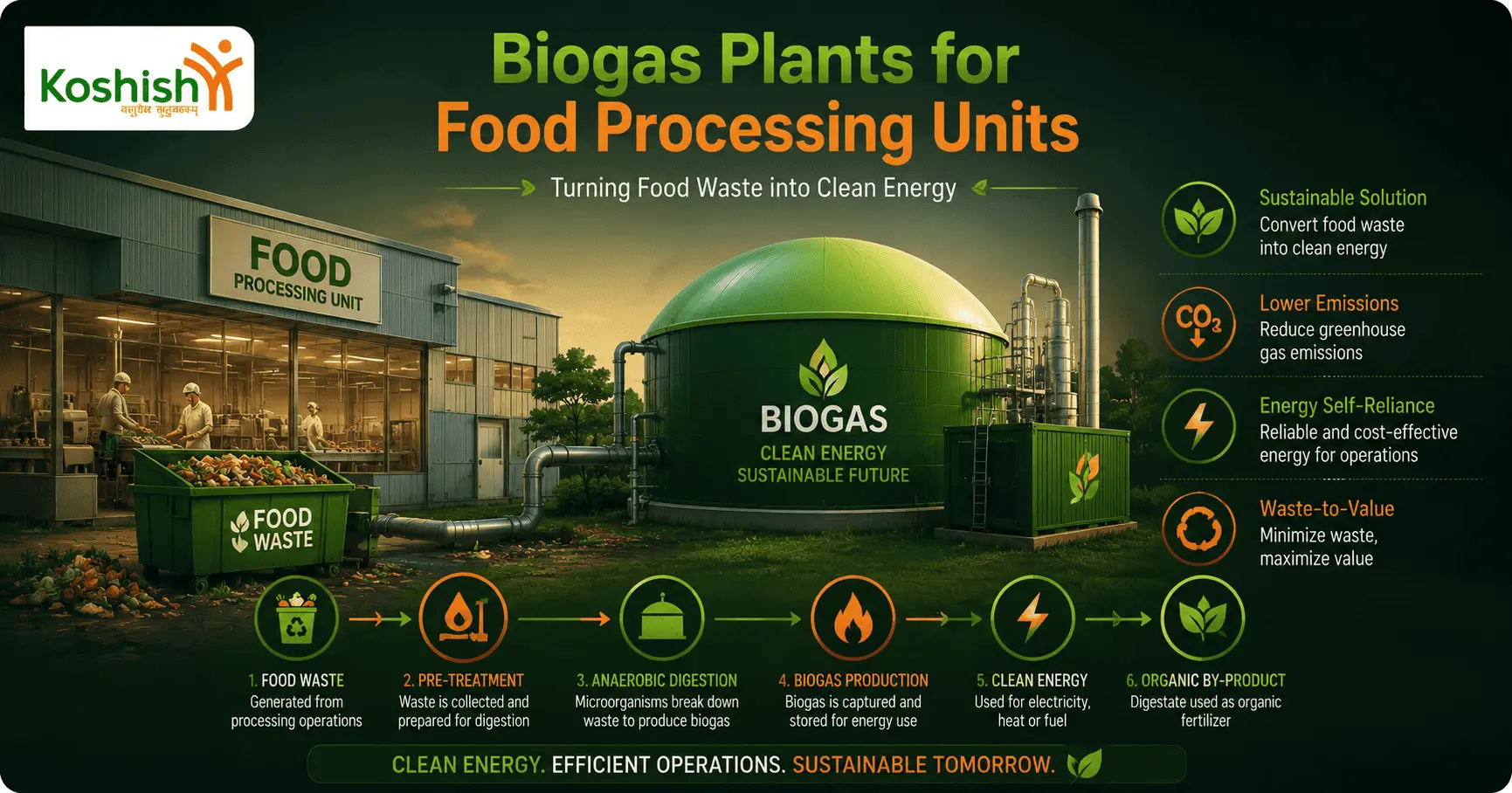
The food industry generates a large volume of food waste, which becomes a huge hurdle in managing it. Industrial biogas plants make food processing waste management more efficient since the food waste is converted into renewable energy through the anaerobic digestion process, which is used for various purposes.
The food waste generated from hotels & restaurants gets dumped in landfills and dumpyards. This leads to pollution and bad odour, which results in the emergence of bacteria. It affects the health of the people living in nearby communities. This food processing waste management reduces the waste disposal costs, offsets the cooking and electricity bills, and reduces the carbon footprint by replacing and lowering the dependency on fossil fuels with a sustainable industrial biogas plant.
This blog is all about how an industrial biogas plant helps with food processing waste management.

Understanding Food Processing Waste Management
Food manufacturing waste is the organic waste that is generated through the production, processing, packaging, and distribution of food products. This includes the raw materials, by-products, rejected samples, and all the food items that are no longer needed in the making of the food manufacturing process. The examples are as follows:- Vegetable & fruit peel-overs, trimmings, and pulp.
- Dairy residues such as whey and spoiled milk products
- Grain husks and processing leftovers
- Dairy and poultry processing waste
- Expired or rejected food products
- Organic sludge from wastewater treatment systems
- Packaging-contaminated food scraps
Challenges Associated with the Conventional Disposal Methods
There are various challenges associated with food processing waste management. Those challenges are as follows: High Waste Disposal Costs: The costs incurred in transporting the food manufacturing waste to dispose of it in landfills can be expensive for the industries producing waste continuously. Bad Smell & Hygiene Problems: Since there is no immediate solution to food processing waste management, the organic waste is dumped in the open, which creates an unhealthy environment and a foul smell. Environmental Pollution: The untreated food manufacturing waste pollutes the soil and water and also leads to greenhouse gas emissions as well. Wastewater Management Challenges: There are several food processing units that generate wastewater with high organic content. This requires proper treatment before discharge to meet environmental regulations. Regulatory Compliance: Industries must comply with increasingly strict waste management and environmental regulations, making waste handling and treatment more complex. There are many other challenges as well that are associated with conventional disposal methods for better food processing waste management.What is an Industrial Biogas Plant?
An industrial biogas plant is a large-scale piece of machinery that converts organic waste to clean energy through anaerobic digestion. This process occurs in an oxygen-free environment where microorganisms break down biodegradable materials and produce a methane-rich gas. Industrial biogas plants are designed to handle waste generated by industries such as food processing, dairy, breweries, distilleries, hotels, slaughterhouses, and agricultural operationsBenefits of an Industrial Biogas Plant
There are various benefits of an industrial biogas plant, which are as follows: Sustainable Waste Management Solution: An industrial biogas plant provides the best food processing waste management. The food manufacturing waste is not dumped idly in an open place but is utilised in generating clean energy, which helps in various errands and protects the environment. Reduction in Disposal Cost: Since the disposal transport costs are expensive. By adopting an industrial biogas plant, that expense is cut off, and the dependency on landfills is eliminated. Reduction in Environmental Pollution: As the food waste is utilised in producing renewable energy, this reduces carbon emissions and lowers the pollution rate. No foul smell is emitted from the landfills. Resource Recovery: The dependency on fossil fuel also reduces by adopting the sustainable solution.Role of an Industrial Biogas Plant in Food Processing Waste Management
The major role of an industrial biogas plant is as a sustainable solution; it helps food factory waste treatment units and organic waste recycling by turning organic waste into sustainable energy & organic fertiliser. They reduce waste disposal costs, control odours, minimise environmental pollution, and support sustainable waste management while generating valuable energy from waste.How Biogas Plants Manage Food Processing Waste
In a food processing waste management unit, there are several steps, which are as follows:- Collection and segregation of food waste streams. The discarded food should be separated; the biodegradable waste is best for digestion and producing methane gas. There should be proper handling of the organic recycling waste for the smooth functioning of the biogas process.
- A continuous feeding system should be there. It is beneficial for the production of methane gas on a large scale; feeding the organic waste recycling should be continuous. So the production of biogas is smooth without any feeding stock deficiency. It has many advantages as well; electricity generation becomes easy, there is a partial cut in electricity bills, and cooking gas is generated.
- The organic waste recycling process becomes smooth. The procedure is simple: food waste is converted to renewable energy and organic fertiliser, and used in several ways. In this way, the world shifts toward a sustainable future by supporting circular economy practises.