


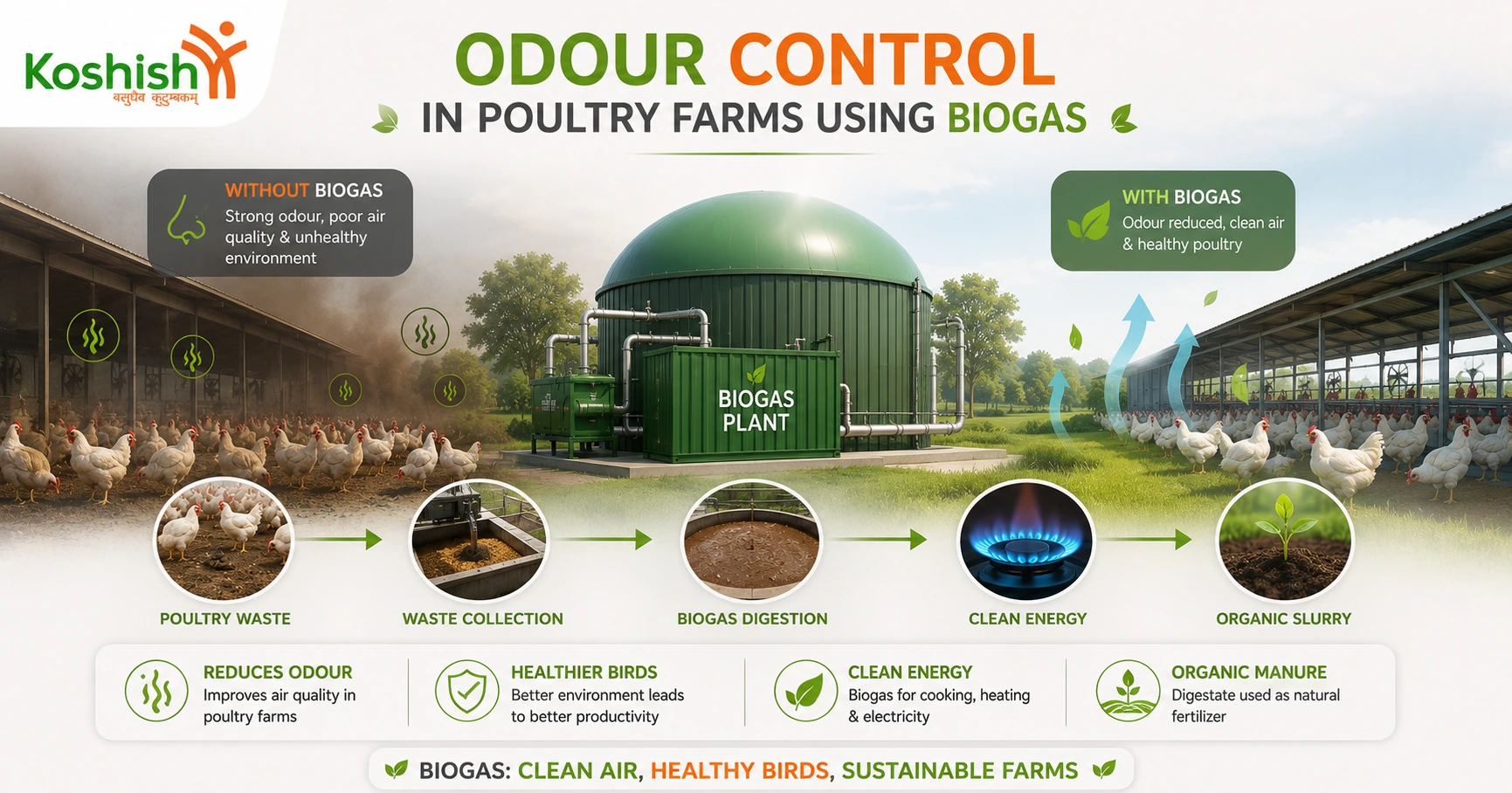
By turning organic waste into clean energy, biogas plants help poultry farm odour control by improving air quality and environmental performance and creating additional economic benefits.
Bad smell from poultry waste has become a serious problem on farms. It affects bird health and reduces their growth. It also creates discomfort for farm workers.
Moreover, nearby people often complain because of the strong smell. When poultry waste breaks down, it releases harmful gases like ammonia and hydrogen sulfide (H₂S). These gases make the air dirty and unsafe.
Fortunately, there is a sustainable solution that does more than just reduce bad smells. Commercial biogas plant technology converts poultry waste into renewable energy while significantly lowering odour-causing emissions.
What Causes Bad Odours in Poultry Farms?
Properly treating litter and feathers makes smell control in poultry farms easier. These wastes release harmful gases that create a bad smell and reduce air quality on the farm. To improve ammonia reduction poultry, it is important to manage waste in a better way. A biogas odour solution can help here because it treats waste and reduces harmful gas release. Poultry waste releases the main gases listed below: Ammonia Emissions: Microorganisms release this gas when they break down poultry manure. It creates a strong bad smell and lowers air quality. A biogas odour solution treats waste properly and reduces bad smell. It also helps control poultry air pollution and keeps the farm clean and safe. Hydrogen Sulfide (H₂S): During decomposition, organic waste H₂S. As a result, it creates a strong rotten egg-like smell on the farm. Poultry farm odour control is mainly needed because two gases cause most of the bad smell, along with a few other factors. Therefore, to improve smell control in poultry farms, it is important to understand these main gases and where they come from.- Poor Manure Management
- Improper Ventilation on the farm
- Also, excessive moisture in the poultry litter.
- Health and Environmental Impact of Poultry Farm Odours
How Biogas Plants Help Control Poultry Farm Air Pollution
After trying different poultry farm odour control methods, it is better to adopt a simple and sustainable biogas odour solution. A biogas plant turns poultry litter into renewable gas and organic manure. Below, we explain how the biogas plant works in simple detail: Anaerobic Digestion process: In this process, microorganisms break down organic matter into small parts inside a closed airtight tank. As a result, the waste decomposes and produces methane Reduction in Ammonia & H₂S: The biogas plant helps reduce ammonia and H₂S gases by converting poultry litter into clean energy. This smell control poultry farm strategy not only reduces ammonia and H₂S gases but also improves overall poultry waste management The additional benefits from biogas plant installation:- Poultry litter waste management becomes easy and effective
- It produces cooking gas, electricity, and organic manure
- Helps generate income by selling organic manure
- It also reduces greenhouse gas (GHG) emissions
- Practical Implementation of Biogas-Based Odour Control
Wrapping Up
As discussed earlier, poultry farm odour control is a big challenge. However, a sustainable biogas odour solution shows that it can be easily achieved. Biogas offers many benefits. It helps control poultry air pollution, manage poultry litter waste, and reduce carbon emissions. In addition, it produces cooking gas, electricity, and organic manure. This creates an extra income source for farmers. Also, nearby communities no longer complain about bad smell. Moreover, the Government of India supports these sustainable practices by offering subsidies.Frequently Asked Questions (FAQ)
How can poultry farm odours be reduced naturally?
Poultry farm odours can be reduced through proper manure management, good ventilation, moisture control, and biogas-based waste treatment systems.
Does a biogas plant eliminate poultry farm smells completely?
A biogas plant reduces bad-smell gases like ammonia and hydrogen sulfide. However, good farm management is still important for best results.
How does biogas help with ammonia reduction in poultry farms?
The anaerobic digestion process breaks down organic waste and stabilizes it. As a result, it reduces the release of ammonia into the surrounding environment.
What gases cause the strongest odours in poultry farms?
Ammonia (NH₃) and hydrogen sulfide (H₂S) are the main gases that cause bad smell in poultry farms.
Can small poultry farms use biogas plants for odour control?
Yes. Small and medium poultry farms can install properly sized biogas systems to manage waste and reduce bad odours effectively.