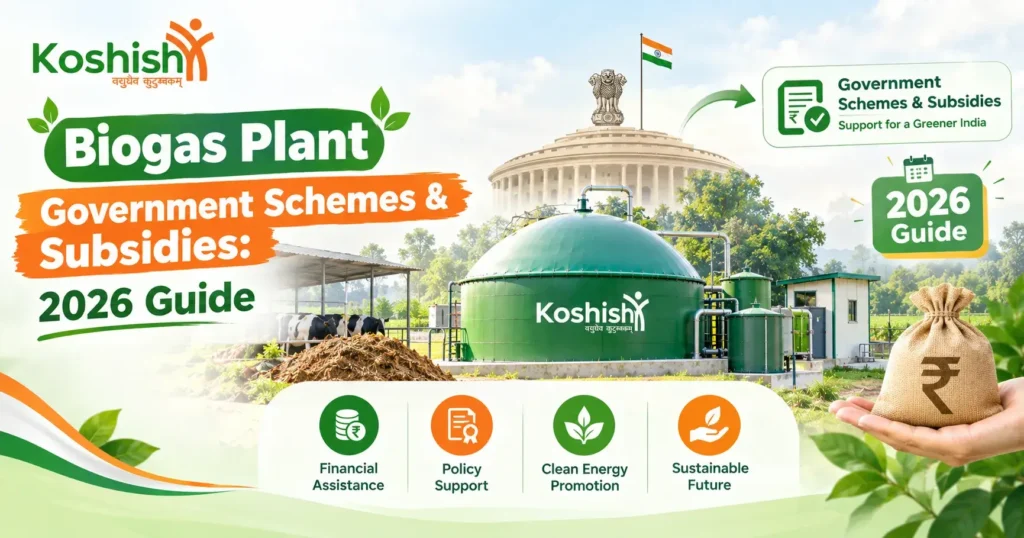

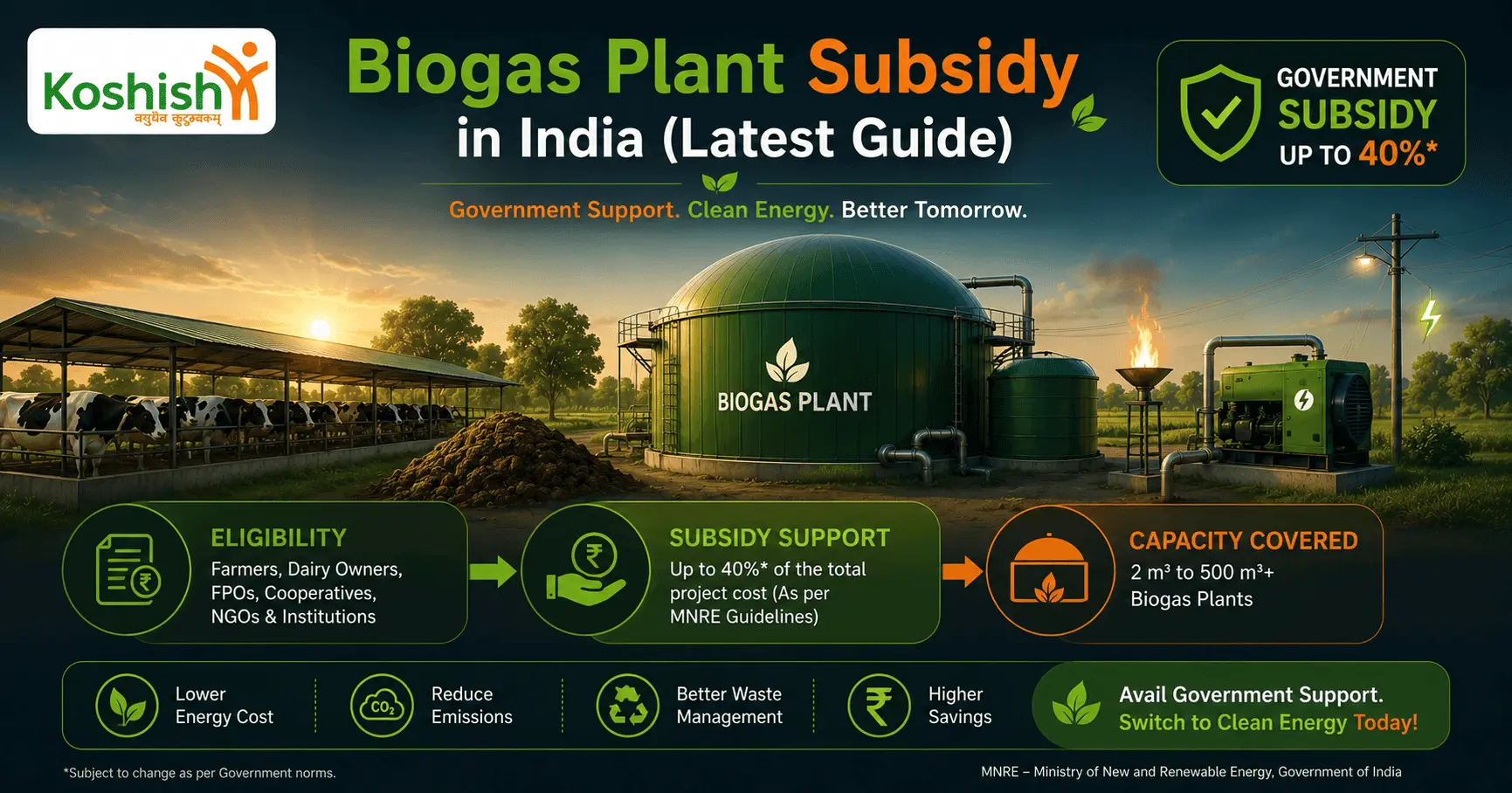
It is a myth that biogas plant subsidies are available for all types of biogas plant designs. The government provides industrial biogas plant subsidies in India rather than dividing them on the basis of sectors. Biogas plant subsidies play a vital role in the lives of farmers who aren’t able to get a biogas plant installed due to the high cost.
As the organic waste is growing, the need for biogas plants has increased in all industries. A biogas plant is the sole sustainable solution that provides renewable energy in return. Also, it turns organic waste into energy, which is used for many purposes, such as cooking gas, power generation, and organic fertiliser.

For example, a 165-cubic-meter plant generates 214.5 kW (units per day): (165 × 1.3 kW)
214.5 units / 10 hours = 21.45 units (per hour)
As a result, 21.45 * 45,000 = ₹965,250, the subsidy amount that farmers can procure.
Why Does the Government Provide Biogas Plant Subsidies in India?
The Indian government is promoting sustainable solutions for a cleaner and greener future. Therefore, it provides biogas funding in India under the MNRE biogas scheme. There are many more reasons for the government to provide biogas plant subsidies in India, which are as follows:- Promote clean and renewable energy.
- Reduce dependence on fossil fuels.
- Encourage scientific waste management.
- Support farmers, industries, dairy farms, gaushalas, municipalities, and entrepreneurs.
- Contribution toward India’s Net Zero and circular economy goals.
Government Subsidy Schemes for Biogas Plants in India
The government of India initiates the MNRE biogas scheme to provide biogas plant subsidies in India, promote sustainability, and give relief to the farmers who are willing to install a commercial biogas plant. Below is the MNRE biogas scheme:- National Bioenergy Programme (MNRE): Under this, CFA (Central Financial Assistance) provides biogas plant subsidies in India for projects for power generation that are eligible. This program is implemented from FY 2021-22 to FY 2025-26. The objective is to promote sustainable waste management practises.
- SATAT Scheme: Under SATAT scheme, a subsidy of ₹4 crore is given for the construction of compressed biogas (CBG). The only motive to promote this scheme is to use all the organic waste to convert it into renewable energy and use it as the best alternative to natural gas and CNG.
What are the eligibility criteria for procuring Biogas Plant Subsidies in India?
To procure the biogas funding in India through the MNRE biogas scheme, those who come under the eligibility criteria for it are as follows:- Individual farmers
- Dairy farms
- Poultry farms
- Gaushalas
- Farmer Producer Organizations (FPOs)
- Industries generating organic waste
- Municipal bodies
- Institutions and commercial establishments
How to Apply for a Biogas Plant Subsidy in India
To apply for the government subsidy for a biogas plant installation, the following steps are as follows:- Choose the appropriate government scheme that works according to the type of plant needed to be built.
- Prepare a Detail Project Report (DPR).
- Select an approved technology/provider (where applicable).
- Submit the application with the documents.
- Site inspection and technical verification.
- Wait for the project approval.
- Then, plant installation and commissioning start.
- Subsidy disbursement after verification.
How to Calculate the Renewable Energy Subsidy
Calculating the biogas plant subsidies in India is simple, according to the MNRE biogas scheme:| Kilowatt | Subsidy Amount |
| 3kW-50kW | ₹45,000 |
| 50kW-200kW | ₹40,000 |
| 200kW-250kW | ₹35,000 |